
Venezuela’s Oil Dominance and Gold Optionality
And How It Compares to the World’s Largest Oil & Gold Nations
Venezuela already occupies a unique position in global commodity markets as the largest holder of proved crude oil reserves in the world. Less widely understood, however, is the country’s potential exposure to one of the largest undeveloped gold systems globally, with government estimates suggesting up to ~8,000 tonnes of gold in situ*.
This report from Cashu Research examines Venezuela’s oil and gold endowment in depth, before placing it within a global ranking of the top 10 countries by combined proved oil and gold reserves, using internationally verified data from 2021–2023. Importantly, this analysis distinguishes clearly between proved reserves and estimated resources, ensuring methodological integrity while still highlighting long-term optionality.
Venezuela: The World’s Largest Proved Oil Reserve Base
Venezuela holds approximately 303.2 billion barrels of proved crude oil reserves, making it the largest oil reserve holder on Earth. These reserves represent roughly 17% of global proved oil reserves and are overwhelmingly concentrated within the Orinoco Oil Belt.
The Orinoco Belt is dominated by extra-heavy crude, which requires more complex upgrading and refining than conventional oil. While this has historically constrained production economics, the scale of the accumulation is unparalleled. Estimates suggest the belt alone contains well over one trillion barrels of oil in place.
Crucially, the U.S. Geological Survey has previously estimated that more than 500 billion barrels may be technically recoverable with advances in extraction technology and supportive economics. This highlights the distinction between Venezuela’s already-record oil reserves and its even larger long-term oil resource optionality.
From a strategic standpoint, Venezuela controls one of the largest single concentrations of recoverable energy globally, giving it enduring relevance in any long-term global energy framework.
Venezuela’s Estimated Gold Endowment: Significant but Unverified*
Beyond oil, Venezuela may also host one of the largest undeveloped gold systems in the world.
The country’s Guayana Shield, particularly the Orinoco Mining Arc, is a highly prospective geological province. Venezuelan government statements have repeatedly suggested that this region may contain up to ~8,000 tonnes of gold in situ*.
* This estimate is based on Venezuelan government statements and has not been independently verified by international geological agencies such as the USGS. It is therefore not classified as proved reserves and should be treated as an indicative resource estimate only.
If independently confirmed and economically recoverable, such a gold endowment would place Venezuela among the largest gold-holding nations globally, rivalled only by Australia and Russia. At present, however, Venezuela does not appear in international rankings of proved gold reserves.
Gold development has been constrained by limited infrastructure, regulatory uncertainty, environmental challenges, and widespread informal mining activity. As such, gold represents long-term optionality rather than a current reserve contributor.
Why the Distinction Between Reserves and Resources Matters
A central principle of commodity analysis is the difference between resources and reserves:
- Reserves are economically extractable under current conditions and independently verified
- Resources represent geological potential that may or may not become viable
Venezuela’s oil dominance is fully captured by proved reserve data. Its gold potential, while substantial, remains outside formal reserve classifications, meaning it cannot be incorporated into quantitative rankings without compromising analytical rigour.
This distinction underpins the global ranking below.
Global Ranking: Top 10 Countries by Combined Oil & Gold Reserves (Reserves Only)
To place Venezuela’s resource profile in a global context, Cashu Research ranked the top 10 countries by combined proved oil and gold reserves, using verified 2021–2023 data from international agencies.
Scoring Methodology
- Oil reserves: Proved crude oil reserves (billion barrels)
- Gold reserves: Economically extractable in-ground gold (tonnes)
- Normalisation:
- Oil divided by the world’s largest oil reserve base (Venezuela ~303 bn bbl)
- Gold divided by the world’s largest gold reserve base (Australia/Russia ~12,000 t)
- Combined Score: Oil fraction + Gold fraction
- Exclusions: Government-estimated or unverified resources
Top 10 Combined Oil & Gold Reserve Holders
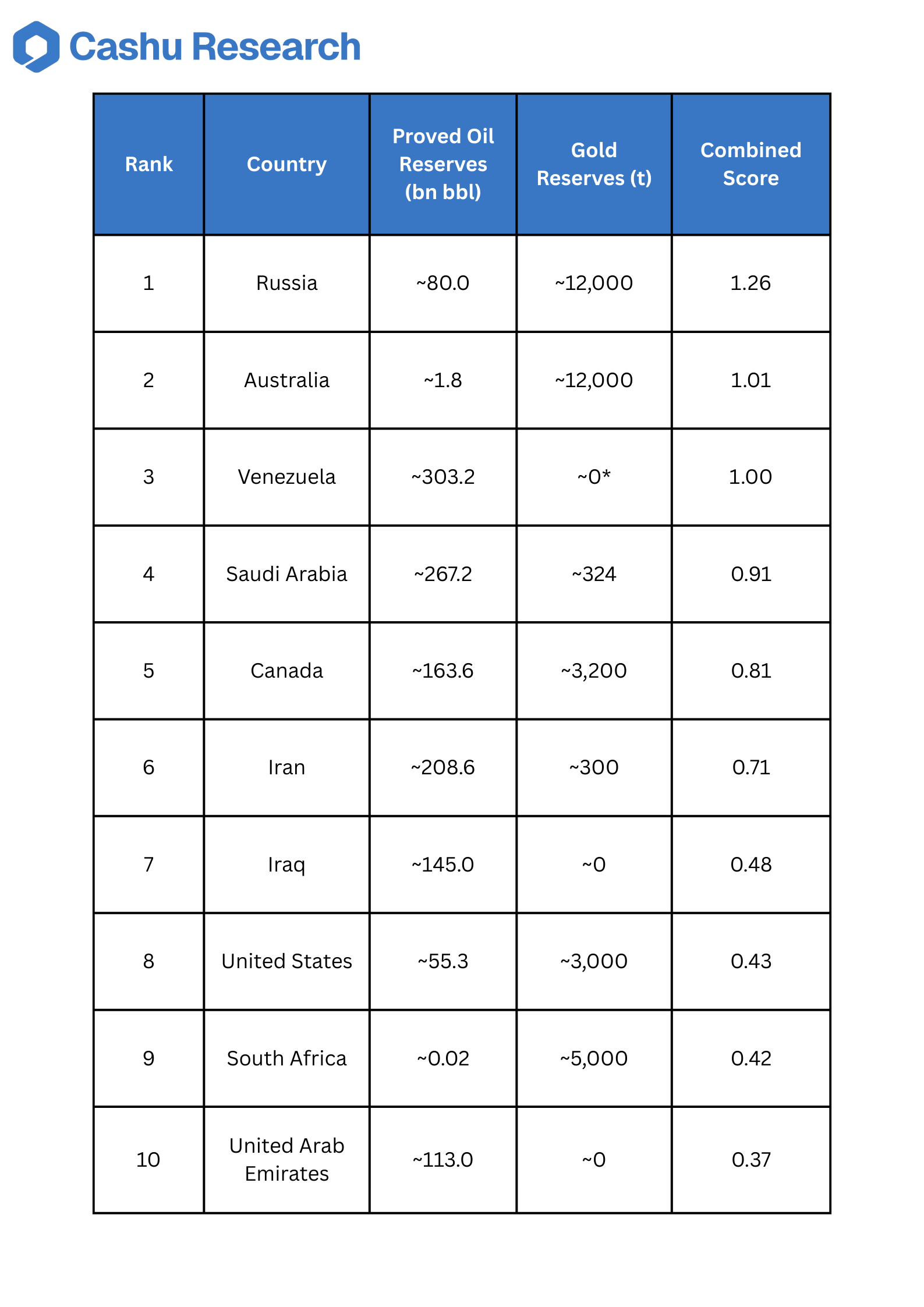
* Venezuela’s gold reserves are not classified as proved reserves by international agencies. Government estimates of ~8,000 tonnes are excluded from scoring.
Interpreting Venezuela’s Position
Under a reserves-only framework, Venezuela’s combined score of ~1.00 is driven almost entirely by oil. As the global benchmark for proved oil reserves, Venezuela receives the maximum oil fraction (1.00), while its gold contribution is effectively zero under international reserve classifications.
This explains why Venezuela ranks:
- Below Russia, which combines substantial oil reserves with the world’s largest verified gold endowment
- Roughly in line with Australia, which has minimal oil but dominant gold reserves
Sensitivity Check: Venezuela’s Gold Optionality (Illustrative Only)
If Venezuela’s government-estimated ~8,000 tonnes of gold were independently verified and reclassified as reserves:
- Gold fraction ≈ 8,000 / 12,000 ≈ 0.67
- Combined score ≈ 1.67
This would place Venezuela clearly #1 globally by a wide margin. This scenario is illustrative only and not incorporated into the ranking.
Key Takeaways for Investors
- Venezuela already controls the largest proved oil reserve base on Earth
- Its total oil and gold resources likely far exceed current reserves
- Gold represents strategic optionality, not present-day reserve strength
- Countries with balanced, verified reserves rank higher than single-commodity giants
- Reserve reclassification — not discovery — is often the catalyst for future ranking shifts
Bottom Line
Venezuela stands apart as the world’s most oil-rich nation by proved reserves. While its estimated gold endowment of ~8,000 tonnes remains unverified, it represents one of the largest latent precious-metal opportunities globally.
Even excluding gold, Venezuela’s resource position is unparalleled. If that gold were ever independently verified and economically developed, it would fundamentally reshape global oil-and-gold rankings.
For commodity investors, Venezuela is a reminder that geology and economics move at different speeds — but when they converge, the implications can be profound.
About Cashu Research
Cashu Research delivers independent, data-driven analysis on global commodities, resource economics, and long-duration supply–demand trends, focused on what is controlled today — and what could matter tomorrow.