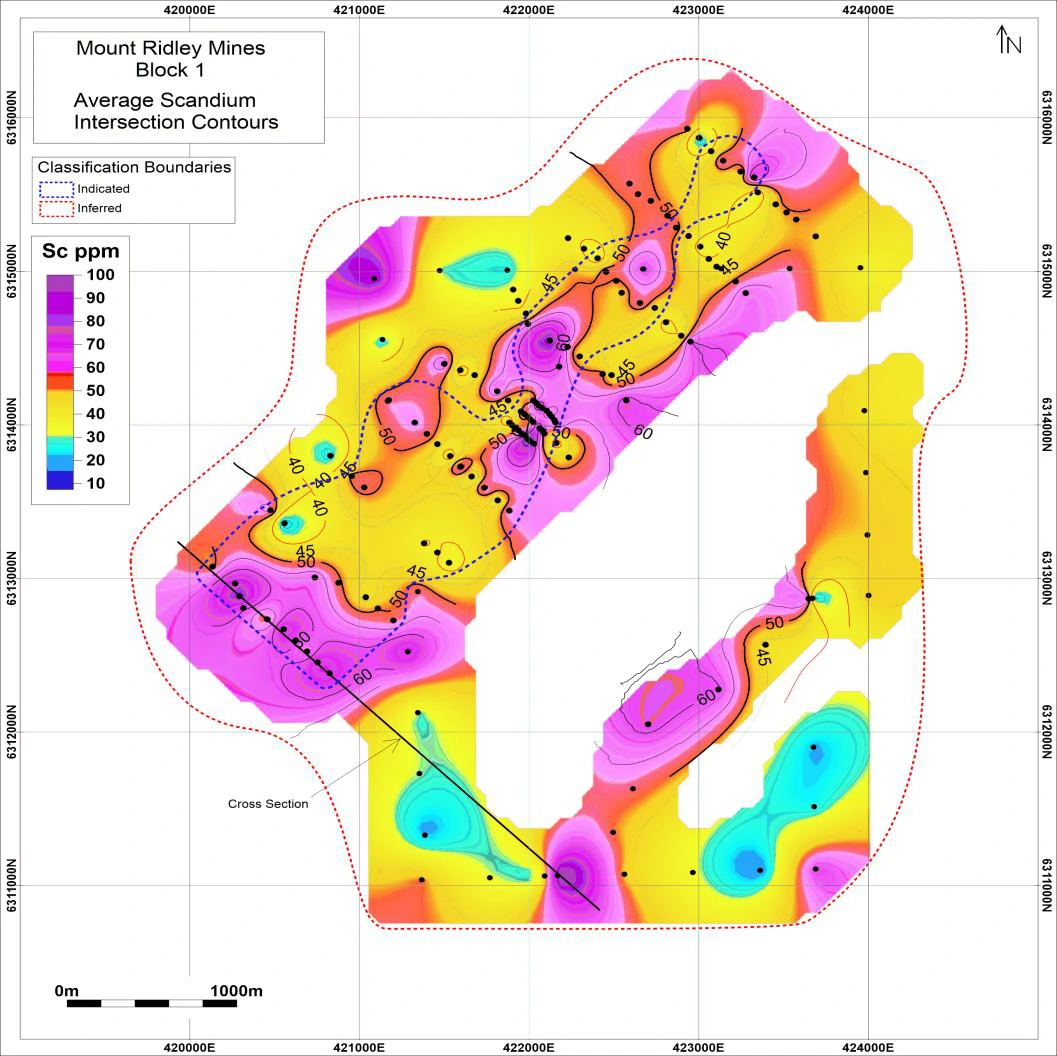
Above: MRD-branded exploration artwork from Cashu Research's existing coverage. The full Block 1 resource map from the announcement appears below.
Mount Ridley Mines (ASX: MRD; OTCID: MRDMF) has upgraded 254.1 million tonnes at 50.0 parts per million scandium at its Grass Patch Project in Western Australia to the Indicated Mineral Resource category. That represents approximately 27% of the existing 946Mt scandium resource and contains a reported 12,700 tonnes of scandium metal.
The key development is greater confidence in part of the deposit, rather than a larger resource. In its 17 November announcement, MRD said the overall tonnage, grade and contained metal remain unchanged from the August estimate. The upgrade gives the company a higher-confidence resource base as it works towards economic evaluation and larger-scale validation of its Selectro™ processing technology.
What changed—and what did not
The maiden Indicated estimate covers portions of Blocks 1 and 2, approximately 25km north of Esperance. Block 1 contributes 92.6Mt at 51.0ppm scandium and Block 2 contributes 161.5Mt at 49.1ppm. The remaining 692.0Mt is classified as Inferred.
| Classification | Tonnage (Mt) | Sc grade (ppm) | Contained Sc (t) |
|---|---|---|---|
| Indicated | 254.1 | 50.0 | 12,700 |
| Inferred | 692.0 | 50.1 | 34,700 |
| Total, as reported | 946 | 50.1 | 47,400 |
Source: announcement Table 1, page 4, using a >25ppm scandium cut-off. Totals may differ due to rounding. Contained metal is an in-ground resource inventory, not recoverable production or a saleable product. Separately, MRD reports 19,400t scandium oxide equivalent (Sc₂O₃) within the Indicated resource and 72,600t across the total resource; oxide-equivalent tonnes and scandium-metal tonnes are not interchangeable.
Verification of historical assays supported the upgrade
MRD said the earlier estimate was entirely Inferred, primarily because there was insufficient quality-assurance and quality-control information for the historical analytical database. A targeted verification program tested archived drill pulps at ALS in Wangara.
The company submitted 224 archived samples, of which 77 were matched to corresponding historical analytical records. It reported a strong correlation between the matched results. The Competent Person considered this verification alongside drill density, geological continuity and other classification criteria when upgrading selected areas. This is a verification-led classification change, not an announcement of additional drilling or newly added resource tonnes.
Why Indicated status matters
An Indicated Mineral Resource carries greater geological confidence than an Inferred estimate. It can support more detailed technical and economic evaluation and, subject to appropriate studies and modifying factors, may ultimately underpin conversion to an Ore Reserve.
This announcement does not establish an Ore Reserve, project economics or a development decision. Most of the resource remains Inferred. Resource scale alone does not demonstrate that scandium can be produced profitably, financed or sold into a sufficiently large market.
Resource confidence and processing are separate development steps
The announcement places the upgrade alongside previously reported Selectro testwork, including 91.8% scandium recovery, average heavy rare earth recoveries of 84% and average light rare earth recoveries of 77% from Grass Patch material. Those are earlier metallurgical results cited for context, not new recoveries established by this resource update.
MRD says it is progressing engineering to inform the design and costing of a planned Selectro demonstration plant, alongside metallurgical optimisation, third-party feedstock testing and engagement with research institutions. These remain development activities: laboratory extraction results do not by themselves prove continuous plant performance, a saleable product or commercial operating costs.
What to watch next
- Larger-scale processing: demonstration-plant design, costing and validation of the flowsheet beyond laboratory tests.
- Economic evaluation: evidence on recoverable products, reagent consumption, capital and operating costs, funding needs and achievable sales.
- Other resource classifications: MRD says classification work on co-located heavy rare earth and gallium resources is progressing; this announcement upgrades scandium only.
- Commercial engagement: progress with potential strategic and offtake partners, without treating discussions as binding contracts or revenue.
For investors, the distinction is important: Grass Patch now has a substantial Indicated component, reducing one source of geological uncertainty. Metallurgy, scale-up, product qualification, market demand, funding and execution remain separate risks.
Source and related coverage
Read the full 17 November 2026 ASX announcement (PDF, 65 pages). Key references: headline figures on page 1; resource table on page 4; verification and classification on pages 5–6; forward work on page 5.
- Cashu's October Selectro and Western scandium supply-chain research update
- Mount Ridley initiation research
- Selectro's first third-party bauxite test
Important information: This news article summarises company-reported information and provides general commentary, not personal financial advice or a new valuation or price target. Mineral Resources are not Ore Reserves, and contained metal does not equal economically recoverable output. Exploration and development investments involve significant risk, including possible loss of capital.