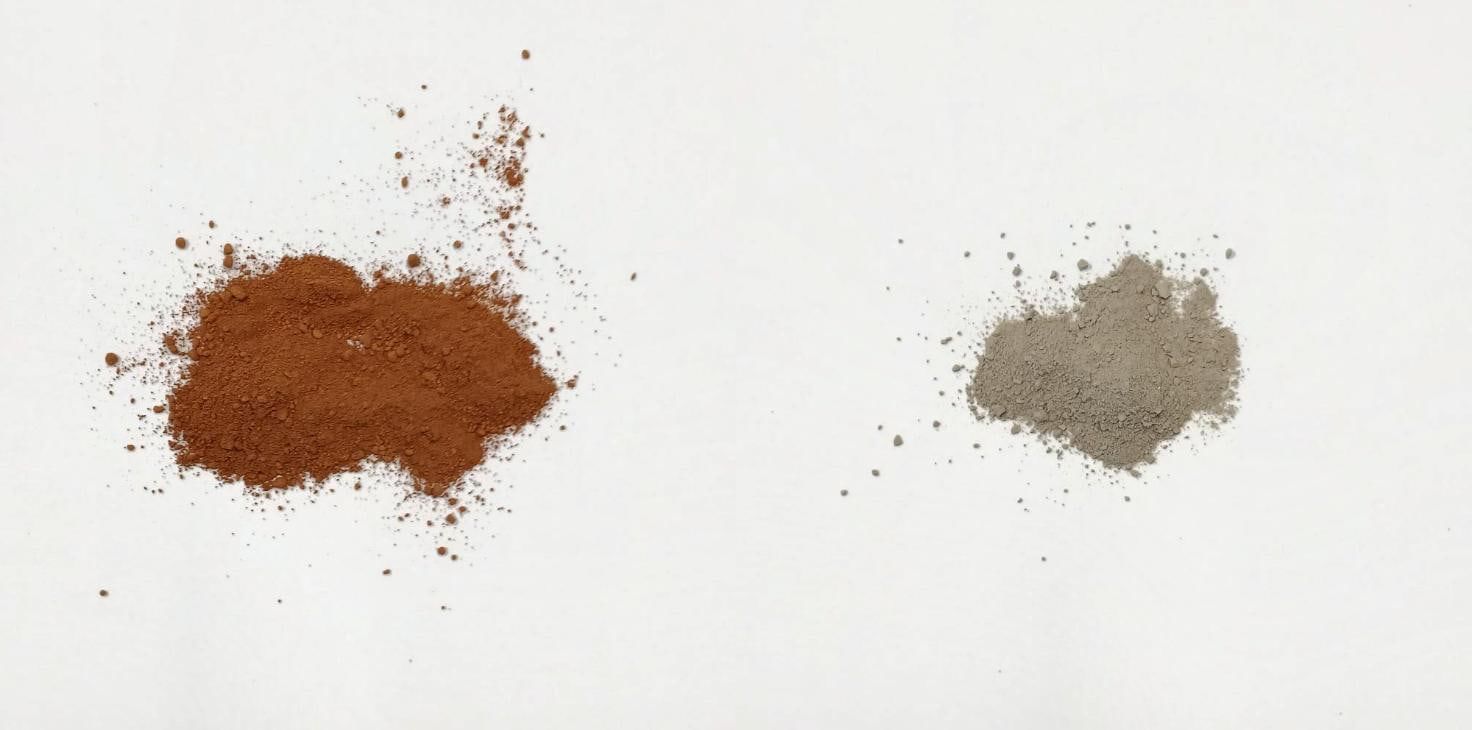
Above: composite bauxite feed (left) and residue from the first Selectro™ leach (right). Laboratory samples, not commercial products. Source: Mount Ridley Mines, 15 October 2026 ASX announcement, Figure 2.
Mount Ridley Mines (ASX: MRD; OTC: MRDMF) has reported Selectro™'s first test on material from outside Grass Patch, directly addressing a catalyst identified in our recent research. A first-pass test on third-party bauxite returned approximately 92% aluminium and 97% iron extraction into solution, extending the evidence for the company's patent-pending process beyond its own critical-mineral feed.
The important development is the change of feedstock, not just the recovery percentages. In our 8 October research update, the first step toward turning Selectro into a processing business was to publish results on suitable material beyond the single Grass Patch composite. This announcement supplies that first off-project result. It does not yet establish a commercial flowsheet, a saleable product or licensing revenue.
The catalyst link to our research
- 17 September: Selectro Test 3. We highlighted improved Grass Patch recoveries, but noted the absence of third-party feed evidence and assigned no value to Selectro licensing.
- 8 October: Selectro and the Western Scandium Supply Chain. We identified third-party feed, scale, saleable product, economics/IP and commercial adoption as distinct tests of the processing opportunity.
- 15 October: first third-party result. MRD reports a successful first-pass bauxite leach. The initial off-project test milestone has been reached; the remaining development steps have not.
Read the full 15 October ASX announcement (PDF)
What the bauxite test showed
According to MRD, Australian Laboratory Services (ALS) conducted the test on a composite supplied by Australian Silica Quartz Group (ASX: ASQ) from its Darling Range bauxite project in Western Australia. The approximately 1kg composite combined 16 selected vacuum-drill samples from four holes across the Athena and Ceres prospects, drilled in 2013 and 2014.
| Element | Head grade (oxide basis) | Extraction into solution |
|---|---|---|
| Aluminium (as Al₂O₃) | 41.9% | 91.9% |
| Iron (as Fe₂O₃) | 13.6% | 96.7% |
The announcement calculates recoveries from head and residue assays. These are leach-extraction results, not recovery through to finished aluminium, refinery-grade alumina or a qualified iron product. MRD says the chemistry has not yet been optimised for bauxite.
The company reports that more than 90% of the silica remained in the residue, which represented approximately 25% of the original dry feed mass. It describes that residue as pH-neutral and silica-rich, rather than the caustic, iron-rich red mud associated with conventional Bayer refining.
There are important sample limitations: MRD has not independently verified ASQ's drilling, sampling or survey data, and the selected composite is not intended to represent the deposit as a whole. Work by an external laboratory on a third-party sample should not be confused with independent validation of an entire commercial process.
Why this matters beyond Grass Patch
Our September note examined Selectro Test 3 on the same unbeneficiated Grass Patch composite used in the earlier programme. That work achieved 91.8% scandium recovery and 84% average heavy rare earth recovery while using approximately half the earlier reagent dose. It was encouraging evidence within one feedstock, but did not establish that the process could work on other material.
The bauxite result addresses that specific limitation. Aluminium-rich bauxite is a different feed from Grass Patch's scandium and rare earth material. A successful first leach on it gives MRD a more credible basis for further external-feed testing and discussions with potential industry partners. It does not show that the chemistry will work equally well on all bauxites or other ores.
The timing is also relevant. MRD says this first third-party result arrived ahead of the Q1 2027 timeframe previously indicated for third-party testwork. That brings forward evidence on the catalyst; it does not mean the broader commercialisation programme is complete.
The Bayer opportunity — and the evidence still needed
MRD sees potential for Selectro as a lower-temperature alternative to Bayer digestion. The bauxite test ran at below 100°C, compared with the announcement's approximately 145°C to more than 250°C range for conventional Bayer digestion, depending on the ore. Keeping silica in a different residue and extracting iron alongside aluminium could also create different processing and by-product options.
Those are potential advantages, not demonstrated whole-of-process savings. Digestion temperature alone does not establish total energy use, emissions, reagent consumption, capital cost or the cost of producing a saleable product. A pH-neutral laboratory residue also does not, by itself, prove that all environmental, disposal and water-management requirements have been met at scale.
The company identifies licensing to existing refiners as a possible adoption route and sees potential in high-reactive-silica bauxite and smaller deposits. Whether those opportunities are economic remains to be tested. No licence agreement or commercial bauxite processing operation is announced in this release.
The next catalysts to watch
- Gallium assays: MRD expects results from a more sensitive assay method within a week of the 15 October announcement. No bauxite gallium recovery result has been reported in this release; earlier Grass Patch results cannot be substituted for it.
- Separation and purification: demonstrate recovery of aluminium and iron products from the leach solution, including purity, impurities and overall product recovery. Extraction into solution is only part of that pathway.
- Grass Patch flotation results: MRD says flotation testwork is complete and assays are pending. The resulting concentrates are then intended for Selectro treatment, testing a different part of the flowsheet from this bauxite experiment.
- Repeatability and more external feeds: optimise the bauxite chemistry and test additional suitable feedstocks, rather than relying on one selected composite.
- Demonstration plant and economics: progress design and construction, complete a mass balance and establish reagent recycling, operating requirements and product samples. MRD says it remains funded to progress the demonstration plant; this is not confirmation that it has been built or that all future development funding is secured.
Our take: one milestone reached, not the whole investment case proven
The announcement matters because it delivers evidence on a condition we explicitly identified in our recent research. Selectro is no longer supported solely by results on the Grass Patch composite. That is a meaningful advance in the processing thesis and a reason to scrutinise the next stage of work, rather than treat third-party applicability as an entirely untested proposition.
Our 8 October update maintained a Speculative Buy rating and A$0.144 target, based on contained scandium and assigning zero value to Selectro licensing. The new result strengthens the case for reassessing that optionality, but a first laboratory leach is not a defensible royalty forecast or an automatic addition to valuation. This news article does not revise that research rating or target.
The next evidence needs to connect extraction to repeatable, saleable products and credible scale-up economics. That remains the distinction between a promising processing technology and a commercial business.
Sources, related research and disclosure
- Mount Ridley Mines, “Selectro™ Delivers 92% Aluminium Recovery from Bauxite in First Third-Party Test”, 15 October 2026. Test methods, exact results and sample limitations: page 2; temperature and demonstration-plant plans: page 3; bauxite opportunities and sample photograph: page 4; gallium timing: page 5.
- Cashu Research, Selectro and the Western Scandium Supply Chain, 8 October 2026.
- Cashu Research, Selectro Test 3, 17 September 2026.
- Cashu Research, Mount Ridley initiation of coverage, 26 August 2026.
Cashu's related MRD research was commissioned and paid for by Mount Ridley Mines Limited. Cashu Research or Cashu Group has received fees for research or corporate communication services from companies mentioned, and its directors, employees or associates may hold or trade those securities. Company test results and plans in this article are attributed to the 15 October announcement. Selectro remains at laboratory-test stage; development, funding and commercialisation risks remain substantial. This is general information, not personal investment advice. Read the linked research and its full disclosures before relying on the historical valuation.