Cashu Ideas · Undervalued Companies · 15 October 2026
General information, not personal financial advice
This is an unpaid report. Cashu confirms no issuer-related funding and no declared Arrow holdings or business relationships for Cashu, relevant affiliates or the analyst/reviewer.
Cashu is not registered in the United States or Canada. The research includes overseas input and AI-assisted writing. Neither overseas preparation nor this notice establishes an exemption from registration requirements.
The BUY rating is a general research opinion. The model target is not a forecast or guaranteed return. This report does not consider your circumstances. Seek independent advice from a professional authorised in your jurisdiction.
Read the full disclosures and distribution restrictions.
Arrow Exploration Corp. (TSXV: AXL) is producing more oil and reporting stronger earnings, but its valuation remains low. Our Cashu Research Report puts the company at 2.2× EV/EBITDA, compared with PetroTal at 2.7×. Arrow also held net cash at its June balance-sheet date.
There are reasons for investors to be cautious. The Tapir contract expires in February 2028, and part of the reserve valuation depends on an extension. The Thorsby acquisition uses cash and brings future decommissioning costs. For the shares to justify a higher valuation, Arrow needs to keep production up without putting too much pressure on its finances.
Market prices and Cashu-normalised metrics are dated 12 October 2026. They are not live quotes. Share prices and normalised valuation metrics are in Canadian dollars (C$); issuer financial figures below are in US dollars (US$). Financial statements cover the period to 30 June 2026. We also draw on Arrow's September 2026 investor presentation. Its development plans are management estimates, not Cashu forecasts or updated financial results.
Key figures
- C$0.72 reference price and C$1.03 model target: a difference of approximately 43.1%, with a target horizon of 14 October 2027. The report's BUY rating is a general research opinion. The target is a model estimate, not a forecast or guaranteed return.
- 26.77% Valuation Index: in Cashu's “Undervalued” band. It measures how cheaply Arrow trades against selected peers, rather than establishing its intrinsic value.
- 2.2× EV/EBITDA and 8.67× trailing P/E: below PetroTal's 2.7× and approximately 10.7×, respectively. Our report also compares InPlay Oil and VAALCO. Negative peer P/Es need care because losses make earnings comparisons less useful.
- US$28.50m cash and US$14.51m working-capital surplus at 30 June 2026. These figures come before the Thorsby cash payment and do not show Arrow's current post-acquisition position.
- Production above 6,000 boe/d in Arrow's 17 September operational update. That was the reported rate at the time, not a promise that it will continue.
Where growth could come from
Arrow has made five discoveries: Icaco, Rio Cravo Este, Carrizales Norte, Mateguafa and Alberta Llanos. Its September presentation also points to more than 215 km² of 3D seismic across two contracts. The company has several areas to develop, although past drilling success does not guarantee that the remaining prospects will be commercial. (Presentation, slide 4.)
The improvement in earnings is already visible. Q2 oil and natural gas revenue rose from US$17.95m to US$39.10m year on year. Issuer-adjusted EBITDA increased from US$6.27m to US$25.16m, while a US$0.93m net loss became a US$10.36m profit. Arrow's 73.5% adjusted EBITDA margin uses net revenue. It has a different basis from Cashu's 58.4% normalised trailing margin, so the two should not be compared directly.
At Icaco, the proposed five-well phase could add production if results support further drilling. Management also expects the conversion of IC-6 to water disposal to lower operating costs. The well was terminated prematurely, so its proposed new use matters, but the cost benefit still needs to be delivered.
The development plan includes horizontal and deviated wells. Arrow also reports licensed water-disposal capacity above 130,000 barrels per day, following ANLA environmental approval. This could help the company handle more water as production grows. It is a permitted disposal limit, not oil-production capacity, actual throughput or a confirmed cost saving. (Presentation, slides 15 and 32.)
The C$12.15m Thorsby acquisition adds a Canadian business to develop. It brings a 100% working interest in 9,501 net acres in Alberta, around 550 boe/d of production at acquisition and 22 management-identified drilling locations. Those locations still need to be drilled successfully before they can contribute production.
The presentation lists 14 producing wells and a proved-development plan covering 18–22 locations on five pads. Management proposes drilling one pad a year and says the asset can grow within cash flow. Whether that happens will depend on well results, oil prices, costs and timing. It is a management plan, not a verified funding commitment. (Presentation, slides 34–35.)
Reserve growth and the Tapir contract
The mid-year reserve update, effective 15 August 2026 and including Thorsby, reports 11.4 MMboe of proved (1P) and 21.4 MMboe of proved-plus-probable (2P) reserves. These are increases of 110% and 82%, respectively. The US$255.8m 2P after-tax NPV10 values reserve cash flows under the evaluation's assumptions. It is not the value of Arrow's equity or a share-price target.
Tapir's contract expiry is important to those assumptions. For Tapir, 1P assumes expiry in February 2028, 2P assumes the first five-year extension and 3P assumes the second. Ecopetrol decides whether to grant the extensions. Management says the contractual obligations have been met, the paperwork submitted and discussions are under way. That does not mean an extension has been granted. Formal assignment of Arrow's beneficial 50% interest also requires Ecopetrol's consent. (Presentation, slides 5, 7 and 13.)
The risks to watch
Thorsby comes with costs beyond the purchase price, including C$8.7m of assumed decommissioning liabilities. The asset generated around C$2.0m of operating income in the preceding twelve months. Future returns will also need to cover development spending and closure costs.
Arrow has spent more on investment than it generated from operations before. FY2025 operating cash flow was US$26.80m, against US$43.19m of capex. H1 2026 capex fell 34.1% year on year to US$17.24m, but further drilling will need funding. June's net-cash position does not, by itself, show that the expansion can pay for itself.
Management describes the 2026 programme as fully financed. It also points to a crude-sales prepayment facility with capacity of up to US$20m followed by US$15m. This is not extra cash to add to the balance sheet. The amount already drawn, remaining availability and future oil-delivery obligations need to be checked before counting on it. (Presentation, slides 33 and 36.)
The Altman Z-Score of 2.63 is in the report's elevated model-risk band, despite the net-cash position. It is a screening measure, not a probability of insolvency. Arrow also trades at around 2.1× book value, so the low earnings multiple does not mean the shares are cheap on every measure.
Oil prices, drilling results, downtime, Colombian contract and country risks, Canadian operating obligations and exchange rates could all affect returns. Our report also flags possible measurement differences in its unusually high payable-days figure. That comparison should not be used to assume reliable supplier financing.
What we are watching
- Production: whether Arrow sustains its reported output and gets the results needed to continue drilling at Icaco.
- Costs: whether the water-disposal changes reduce operating costs as expected.
- Cash: the next balance sheet after the Thorsby payment, with an allowance for drilling and decommissioning obligations.
- Tapir: progress on the contract extension and formal assignment.
- Earnings: whether profits and operating cash flow hold up as the development programme advances.
Understanding Cashu's model
The C$1.03 Cashu Target Price comes from a bounded relative-valuation model. It uses the Valuation Index and how it changes against peers and Arrow's own valuation history. It is not a discounted-cash-flow valuation, a probability-weighted forecast or a promise that the shares will reach that price by October 2027.
The 67.56% Target Index puts Arrow in the model's “Extremely Attractive Target” band. This does not mean anyone is considering a takeover. The index shares valuation inputs with the Valuation Index, so it is not a separate confirmation of cheapness. The 70.04% Sentiment Index is in the “Extremely Bullish” band. It uses price and volume data, which cannot tell us whether institutions or retail investors are buying.
Issuer-adjusted, Cashu-normalised and reported accounting measures use different definitions. Normalisation helps compare companies, but it does not prove that earnings will continue. The downloadable Cashu Research Report includes the financial analysis and glossary, with updated publication disclosures.
Important publication disclosures
Publication disclosures updated 16 October 2026. The financial snapshot is unchanged.
General information, not personal financial advice
This is impersonal research commentary for general information, not personal financial advice. It does not consider any reader's objectives, financial situation or needs. The Cashu Research Report's BUY label expresses a general research opinion, not a personalised recommendation or instruction to trade. Nothing here is an offer to sell or solicitation to buy securities. Obtain independent advice from a professional authorised in your jurisdiction. Investments can lose value, including the entire amount invested.
Unpaid report and declared interests
Cashu confirms that this report is unpaid and that it has received no compensation for it. Cashu has confirmed no issuer-related funding or expected issuer/promoter compensation for this report, and no Arrow-related holdings or business relationships for Cashu, relevant affiliates or the analyst/reviewer. These are publisher-provided declarations for this publication, not an independent audit. Material changes require updated disclosure.
Publisher, overseas input and AI assistance
Published by Cashu Research. Research preparation includes overseas input. The Cashu Research Report describes narrative generated by Cashu's research agent using large-language-model synthesis, structured platform data and public-web sources. No individual analyst's location, regulatory credentials or personal analyst certification is represented or verified in this publication. Overseas preparation does not establish an exemption from applicable securities laws.
United States, Canada and distribution
Cashu has advised that it does not hold securities registration in the United States or Canada. Australian authorisation is not US or Canadian registration, endorsement or approval. This publication does not provide personalised advisory, brokerage or trade-execution services. Availability online does not establish eligibility for distribution to every jurisdiction or reader class. It must not be distributed or used where unlawful. No US publisher, foreign-research, Canadian general-advice or other registration exemption is asserted solely by this notice. Applicable registration, analyst-certification, promotion and distribution requirements depend on the activities, audience and jurisdiction; qualified legal/compliance review is required before relying on an exemption.
Dates, currencies and model limitations
The Cashu Research Report is dated 15 October 2026. Its market and Cashu-normalised valuation snapshot is as of 12 October 2026; financial statements are to 30 June 2026. Market/normalised metrics and share prices are in Canadian dollars unless stated otherwise; issuer financial statements retain their reported US-dollar basis. The C$1.03 model target and 43.1% implied upside from C$0.72 are valuation references through the stated 14 October 2027 horizon, not forecasts, probabilities or guaranteed returns. Peer selection, normalisation and future earnings can materially affect the result. Target Index is not evidence of a takeover; Sentiment Index is inferred from price/volume, not identified investor holdings.
Sources, verification and responsibility
The Cashu Research Report attributes platform fundamentals and comparisons to licensed S&P Global Market Intelligence feeds and issuer information to the named public releases and financial statements. These source and licensing statements describe the Cashu Research Report's methodology, not independently verified feed audits. AI-assisted synthesis can contain errors. No assurance of accuracy, completeness or future performance is given, subject to rights and liabilities that cannot lawfully be excluded. Verify material claims against primary sources. Original financial figures and model targets have not been recalculated. The web article adds dated management context from Arrow's September 2026 corporate presentation; those statements are issuer estimates and plans, not independent verification or Cashu forecasts. The previous blanket FINRA classification and on-request conflicts wording have been replaced.
Sources and related reading
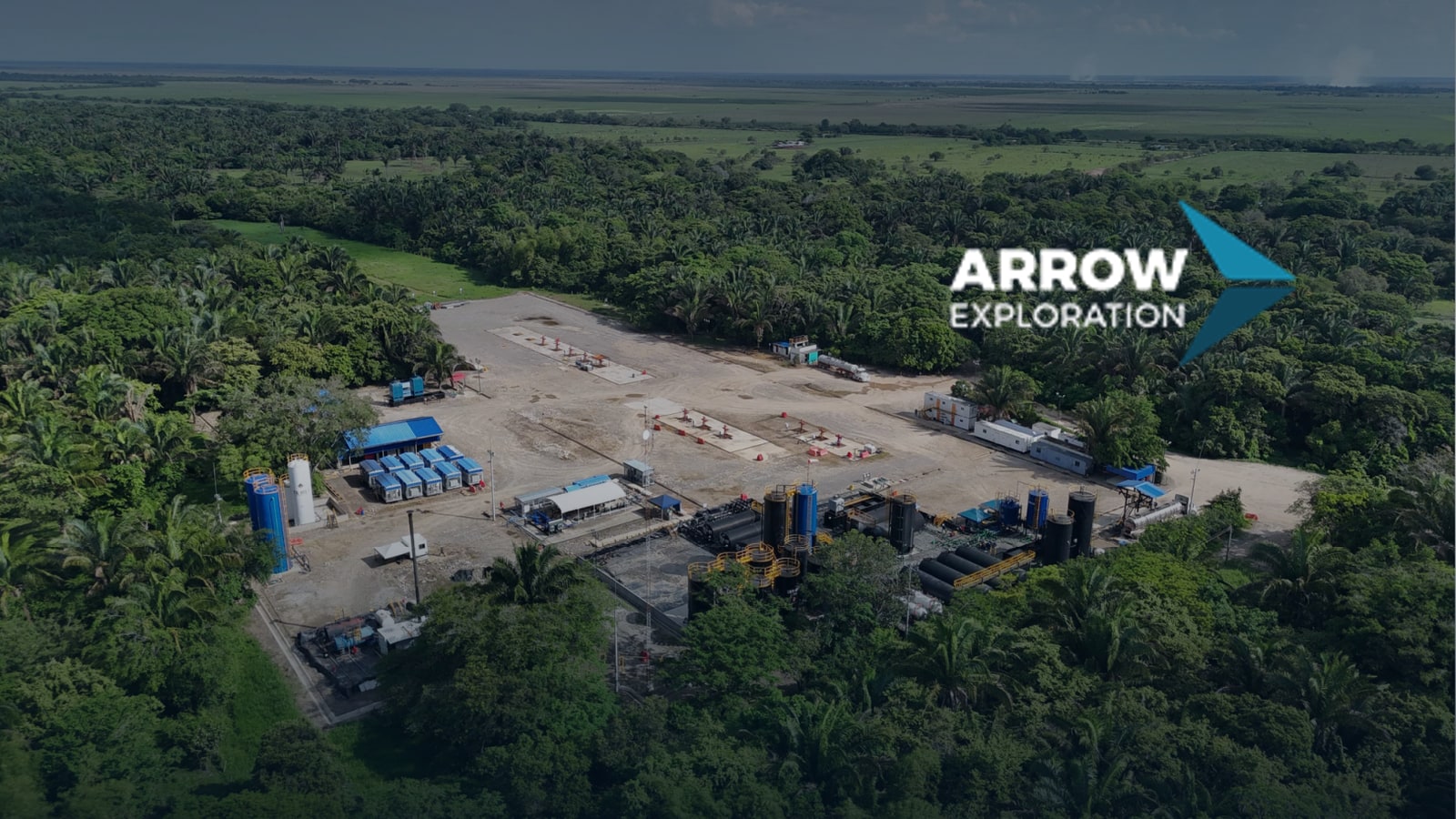
- Arrow Exploration, Corporate Presentation, September 2026 (September 21 file), slides 4–5, 7, 13, 15 and 32–36. The operating and development plans discussed above are management's estimates. The thumbnail uses Arrow's logo and a field photograph from slide 33. This does not imply issuer funding or endorsement.
- Cashu Research Report: Arrow Exploration, dated 15 October 2026; platform metrics as of 12 October 2026. The report references Arrow's Q2/H1 2026 financial statements, authorised 26 August 2026; FY2025 annual report, 28 April 2026; and operational/acquisition releases dated 13 August, 4 September and 17 September 2026.
- Previous Cashu Ideas edition: Global Ship Lease and its undervalued charter portfolio.
Download the four-page Cashu Research Report for the financial analysis, glossary and full disclosures. Its financial figures and model target have not been recalculated.