
By @Fox · Cashu Research · Market note · Small caps & M&A · 19 November 2026. All dollar amounts are Australian dollars unless stated otherwise. Hero image: AI-generated editorial illustration.
House view: Australian small caps deserve a closer look when private buyers are willing to pay substantial premiums to their quoted prices. We would rather identify good businesses before the bid than rely on a buyer to recognise their value for us.
Disclosure: As at 19 November 2026, Cashu and its associates have no holdings in the companies mentioned. This note was not commissioned or paid for by any company mentioned.
The bids keep coming
In recent days, US private equity firm Haveli proposed paying A$2.75 a share for Nuix (ASX: NXL), a 73.0% premium to its 17 November close. Hungarian drugmaker Gedeon Richter agreed to acquire Mayne Pharma (ASX: MYX) for A$6.40 a share, a 99.4% premium to its 16 November close. G8 Education (ASX: GEM) entered exclusive discussions over a 26-cent proposal, 160% above its last close. Big River Industries (ASX: BRI) signed a scheme implementation deed at A$1.62 a share, a 45.9% premium.
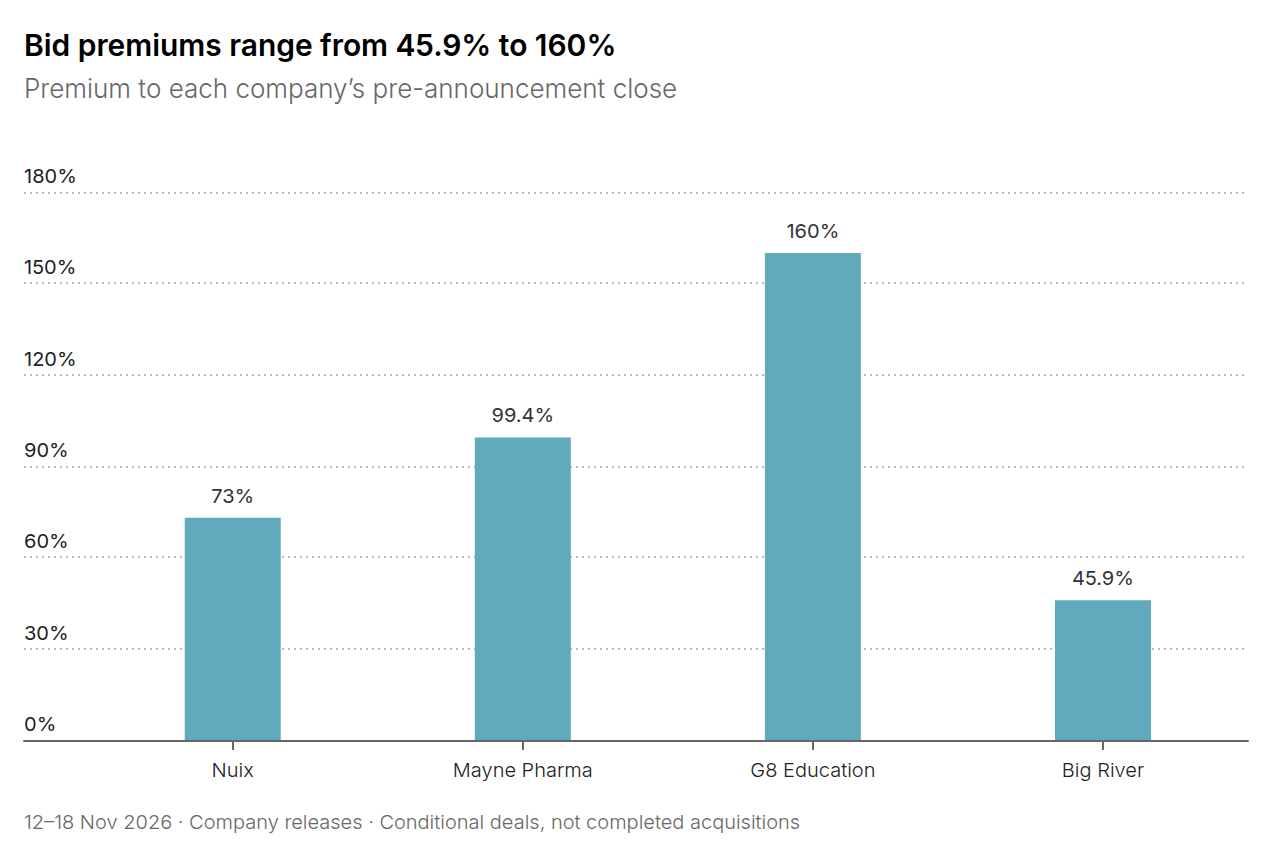
Those percentages use the different pre-announcement closing prices specified by each company. They are not investment returns available to someone buying after the announcements.
Headline consideration also needs to be read with its adjustments: G8's proposed price is reduced by future dividends, and Big River's A$1.62 consideration is reduced by any applicable special dividend under the scheme terms.
The deal stages matter. Nuix's approach and G8's proposal remain conditional and non-binding. The Mayne Pharma and Big River schemes also require conditions and approvals to be satisfied. Announcing a deal is not the same as completing one.
The pattern extends beyond these four names. Clayton Utz's 5 November review of ASX take-privates describes a broad range of proposed acquisitions across industrials, financial services and other sectors. Some are large-cap transactions, so this is not exclusively a small-cap story.
The useful takeaway is not that every bid proves the market wrong. It is that private buyers are repeatedly finding value that the quoted market has not been recognising. Control, synergies and a buyer's longer investment horizon can explain some of the premium; they do not make every target a bargain for a minority investor.
How cheap is cheap?
The performance gap is unusual. In an early-November commentary, Maple-Brown Abbott's Phillip Hudak reported that the Small Ordinaries had underperformed the ASX 100 by 19% over the preceding 12 months, a gap seen only three times since 2002. That is the period used in his commentary, not an updated year-to-date return as at this article's publication.
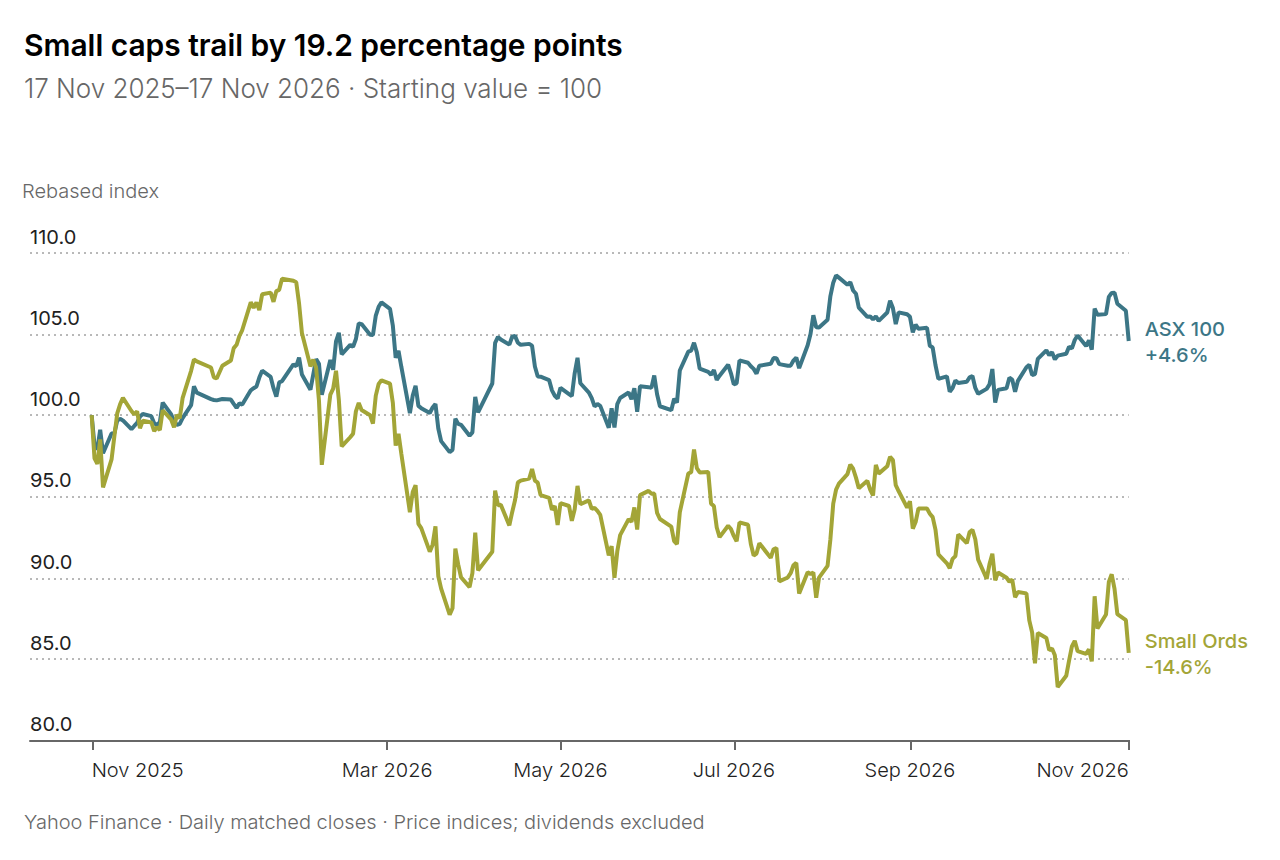
Fund flows, benchmark concentration and financing conditions can put pressure on smaller quoted companies without telling the whole story about their long-term earning power. But those pressures are not purely technical. Smaller businesses can also face more expensive debt, weaker demand and genuine earnings risk.
Our preference is to examine the valuation gap company by company: cash generation, balance-sheet strength, recurring revenue and the price an informed owner might rationally pay. A low multiple is a starting point for research, not proof that the market must re-rate a stock.
Private buyers are looking at different numbers
Private equity and offshore trade buyers can look beyond index weights and monthly fund flows. They focus on cash flow, strategic fit, financing and what it would cost to build a comparable business. That can produce a different valuation from the one set by a thinly traded share register.
Financing conditions also matter. Clayton Utz says banks are returning to leveraged lending and considering some transactions with leverage of up to 6.5 times. That is its observation about particular transactions, not a standard debt multiple available to every buyer or target. Its review also identifies stress in parts of private credit: funding is not uniformly easy.
Bidders keep coming back. Haveli made earlier proposals for Nuix at lower prices before the A$2.75 approach became public. Clayton Utz notes that bidders in Steadfast and Reliance Worldwide revised their prices up to three times before obtaining exclusivity. A rejected first approach can be an opening move, although some buyers walk away.
That is why we are watching the terms and the process, not simply the headline premium. Due diligence, financing, regulatory conditions, board support and competing offers can change the outcome.
Why the drain matters
When a good business leaves the exchange, public-market investors lose the ability to participate in its next phase on the same terms. If a private owner later relists it, the valuation and capital structure may be very different. A higher relisting price is possible, not guaranteed.
A smaller pool of listed businesses can also reduce the choices available to investors and the depth of sector coverage. The concern is most acute where departures are not matched by attractive new listings. The answer is not to resist every takeover; it is to make sure public-market prices and board decisions adequately reflect a business's prospects.
What we think investors should look for
- Businesses worth holding without a bid. Start with earnings quality, cash generation, funding needs and valuation. Takeover optionality is more useful when the standalone investment case already works.
- Rejected approaches. A previous proposal is evidence of past interest, not a floor under the share price or an assurance that the same buyer will return.
- Disclosed changes on the register and strategic reviews. Substantial-holder notices and formal board announcements are better evidence than unexplained volume or market rumours. Neither establishes that a takeover is coming.
- Real risks as well as catalysts. Weak earnings, dilution, debt and deteriorating demand can make a company look cheap for good reason.
Five we're watching
These are a watchlist, not five announced takeover deals or guaranteed winners. Each has a prior approach, a disclosed strategic development or an industry connection worth investigating. The cases are different, and so are the risks.
ReadyTech (ASX: RDY)
In June, ReadyTech rejected a non-binding approach from Total Specific Solutions, a Topicus subsidiary. The proposal paired a A$2.00-a-share scheme with an alternative A$1.75 off-market bid, subject to its stated conditions. The board said it did not reflect ReadyTech's inherent value in a change-of-control context.
The subsequent FY26 result recorded revenue growth of 2.6% to approximately A$125.0 million. That gives investors a real test: can the recurring-revenue business restore growth and cash margins? The old proposal shows strategic interest; it is not a current executable offer.
Main risk: growth remains subdued, the turnaround takes longer than expected and the previous bidder does not return.
Monash IVF (ASX: MVF)
Monash IVF rejected an 80-cent approach in November 2025 and then a revised 90-cent proposal from the Genesis Capital and Soul Patts consortium in April 2026. Its 20 April announcement said it remained open to a change-of-control transaction at a higher valuation, while stressing that there was no certainty of a transaction.
Two rejected proposals establish buyer interest at those earlier dates. They do not establish that a new approach is imminent, that 90 cents remains available, or that the business's prospects have stayed the same.
Main risk: operational performance disappoints or a future proposal, if one emerges, is lower rather than higher.
Aerometrex (ASX: AMX)
Aerometrex's 5 November strategic-review announcement confirmed that advisers were examining options including standalone growth, potential corporate transactions and alternative capital structures. It said no option had been selected and no transaction was certain.
A substantial-holder notice reported on 11 November disclosed Landchecker's 18.58% voting power, including relevant interests arising from a right-of-first-refusal arrangement. That is not the same as saying every share was acquired outright. Landchecker is also an established MetroMap distribution partner, giving the relationship a commercial basis beyond a financial investment.
Main risk: the review produces no transaction and the market overprices the significance of a strategic investor's interest.
Antipa Minerals (ASX: AZY)
Antipa's Minyari Dome gold-copper development is approximately 35 kilometres from Greatland's Telfer mine and processing facility in Western Australia's Paterson Province. That proximity gives investors a strategic question to examine, not evidence of a bid.
The company's September-quarter report, released on 27 October, reported A$28.0 million cash at 30 September 2026 and no debt. It also described a strategy of progressing Minyari Dome towards a potential standalone operation. We would assess that development case and future funding needs alongside any regional consolidation possibility.
Main risk: development, funding and execution take longer or cost more than expected, while any potential acquirer has other priorities. Proximity to infrastructure does not establish access to it or a commercial processing agreement.
Bapcor (ASX: BAP)
Bapcor rejected Bain Capital's A$5.40-a-share proposal in 2024. It has since undergone a material operating and balance-sheet reset. That historical price is not a current valuation floor, and subsequent capital raising means per-share comparisons need care.
The FY26 result reported underlying EBITDA of A$152.5 million, above the top end of its May guidance range, and net bank debt of approximately A$135 million following the February 2026 equity raising and improved cash generation. It also reported a statutory loss of A$431.6 million, including substantial impairments and other significant items. This remains a turnaround, not a simple return to the old bid price.
Main risk: earnings recovery disappoints or funding constraints reduce shareholder value before any strategic buyer is prepared to act.
What boards should take from this
If the market does not understand your business, someone else may put a price on it first. A bid can look generous against a depressed share price and still leave a debate about the company's standalone value.
Clear communication with the right investors can improve understanding of a business, its risks and its strategy. It cannot guarantee liquidity, a higher share price or protection from an opportunistic approach. Boards still need to assess the offer, the alternatives and what shareholders can realistically expect.
Our house view is that the takeover activity is a reason to do more work on neglected small caps—not a reason to buy indiscriminately. The best candidates remain businesses we would be comfortable evaluating on their standalone merits, whether or not a bidder appears.
Disclosures
This note contains general financial information and investment commentary and, where it constitutes financial product advice, general advice only. It does not take account of any particular person's objectives, financial situation or needs. Consider whether it is appropriate for your circumstances and seek advice from a suitably licensed professional before acting.
Cashu Technologies Pty Ltd is an Authorised Representative (AR No. 001318029) of Adviser Solutions Group Pty Ltd (AFSL 485946). As at 19 November 2026, Cashu and its associates have no holdings in the companies mentioned. This note was not commissioned or paid for by any company mentioned.
Source documents and reported deal terms are dated as linked and reflect information reviewed for this 19 November 2026 note; they are not continuously updated. Indicative proposals, past approaches and signed conditional schemes are different stages and do not assure completion. Opinions about future approaches and business values are Cashu's views, not statements of confirmed negotiations. Past performance does not reliably predict future performance. Read our Disclosures & Distribution alongside this article.