Most people have never heard of scandium. In 2025 the whole world produced only about 80 tonnes of scandium oxide equivalent, a few truckloads, according to the US Geological Survey. China was the leading producer.
That would not matter much if demand were standing still. It isn't. Bloom Energy, which makes fuel cells that power AI data centres, uses scandium in every unit it ships. On some estimates Bloom alone could need more than twice today's global output within the decade. Defence contractors want more of it too, for lighter, stronger aluminium in aircraft.
Since April 2025, China has required export approval for specified scandium products. The Oregon Group reported that Chinese scandium exports fell to zero in August 2026; that is a reported monthly trade outcome, not proof of a permanent export ban. The US and Canada have responded by supporting alternative supply, including a conditional US$400 million Pentagon loan commitment to Sunrise Energy Metals in New South Wales. Major new Australian mine capacity is targeted for 2028 or later, subject to project execution.
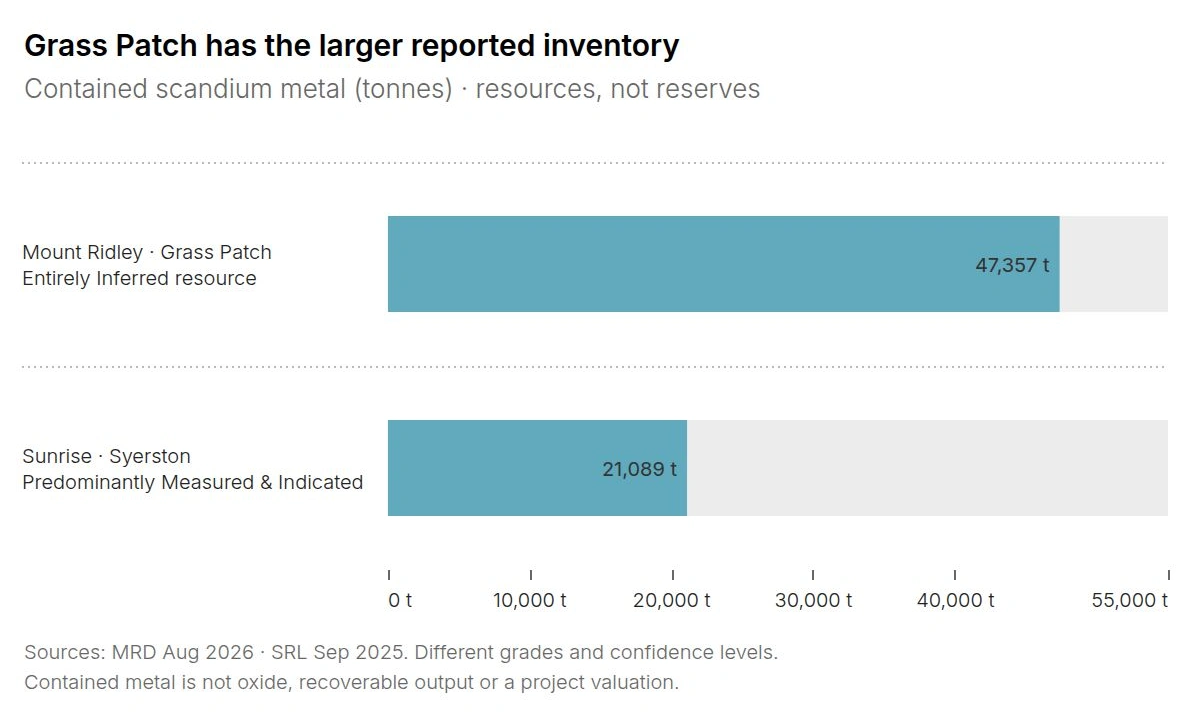
Mount Ridley Mines (ASX: MRD) sits in the middle of this. Its Grass Patch project near Esperance in Western Australia has an Inferred resource containing 47,357 tonnes of scandium metal, which the company describes as the largest publicly reported JORC 2012 scandium resource. That is more than twice the contained metal in Sunrise’s reported Syerston resource, but resource confidence, grade, processing and development maturity differ materially. The supplied early-November snapshot values Mount Ridley at around A$60 million.
This article covers where scandium comes from today, who needs it, what Bloom's supply chain looks like, and what new supply is coming.
Paid research disclosure: Cashu Research has been commissioned by Mount Ridley Mines (ASX: MRD) to provide research. Mount Ridley is a paying client of Cashu Group. Read the full disclosure below.
Units and date: Supply, consumption and capacity figures are tonnes of scandium oxide (Sc₂O₃) unless stated otherwise. Resource inventories and ore grades are contained scandium metal (Sc). They are not interchangeable. This article is dated 12 November 2026; market values are snapshots, not live quotes.
What scandium is and why it matters
Scandium is a soft, silvery metal. There is plenty of it in the earth's crust, more than lead, but it is spread very thinly. It almost never builds up in one place in enough quantity to be worth mining for its own sake (Bloom Energy).
Nearly all commercial scandium supply has historically been recovered as a by-product. Plants processing nickel, titanium or uranium can extract scandium from their process streams. Dedicated scandium projects are being developed, but finding scandium in the ground is not the same as producing a qualified product economically.
The USGS puts 2025 production at about 80 tonnes and consumption at about 60 tonnes, both on a scandium oxide-equivalent basis. Some industry sources give lower estimates using different scope or definitions, so they should not be treated as directly comparable. Producers do not consistently disclose volumes. The small scale matters, but those USGS annual figures alone do not show a current global deficit.
Scandium has two main uses. Added to aluminium in tiny amounts, it makes the metal much stronger and easier to weld without adding weight, which matters for aircraft and military vehicles. In fuel cells, a small amount mixed into the ceramic core helps the cell produce more power and last longer. It is also starting to appear in the chips that handle radio signals in 5G phones, radar and satellites.
The US, EU, Canada and Australia all identify scandium as a critical mineral. USGS reports 100% US net import reliance and no recycling, while describing plans to procure material for the National Defense Stockpile. In a market this small, one large buyer or a licensing disruption can materially change the supply available to particular customers.
Where it comes from today
China is the biggest producer by a long way. The USGS doesn't give exact country shares, but industry estimates put roughly 80 to 90% of the world's refined scandium in Chinese hands (Crux Investor; Barchart). One Chinese company, Hunan Oriental Scandium, says it supplies more than half the world's fuel-cell grade material (Mining.com).
Outside China there are few established sources. Sumitomo Metal Mining recovers scandium from nickel processing at Taganito in the Philippines and refines it in Japan. USGS assigns 89% of US scandium oxide imports in 2021–24 to Japan and 11% to China. Japan is the country of final refining in that statistic; it does not establish the upstream origin of every Japanese shipment. Russia, Kazakhstan and Ukraine have historically produced small quantities.
In North America, Rio Tinto recovers scandium from titanium-process waste at Sorel-Tracy in Quebec. A 1 November 2025 announcement described approximately C$25 million of Canada Growth Fund investment to expand nameplate capacity to 9 tonnes of scandium oxide a year. USGS also described US plans to procure more than 6 tonnes over five years from the Canadian source. Planned procurement and expansion are not proof that the full capacity is already operating.
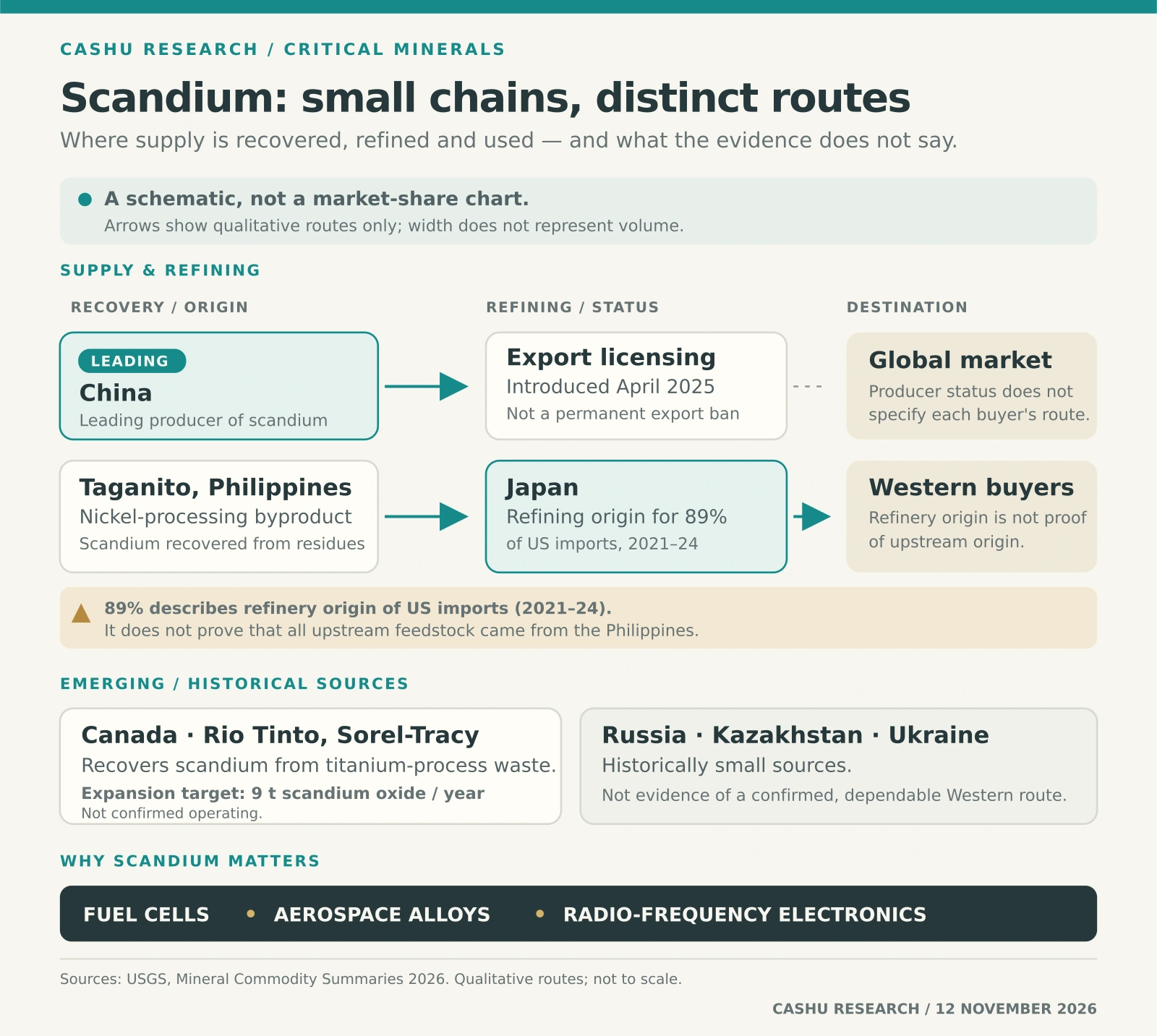
For Western buyers, the disclosed Philippine–Japanese route and Canadian recovery plant are useful alternatives, but neither establishes the quantity of uncommitted, specification-qualified material available to any particular customer.
China's export controls
In April 2025 China added specified scandium metals, oxides, alloys and compounds to its export controls. Export approval requirements should be distinguished from broader rare-earth restrictions and later suspensions. US chipmakers reported licensing delays in February 2026, while The Oregon Group subsequently reported zero Chinese scandium exports in August 2026. Licensing, destination, product form and actual availability all matter.
The US and Canada have responded with a run of funding and purchase deals:
| Date | Event |
|---|---|
| Aug 2026 | Pentagon Office of Strategic Capital offers Sunrise Energy Metals a conditional US$400m loan for Syerston |
| Aug 2026 | Chinese scandium exports reported at zero |
| Feb 2026 | US chipmakers report delays securing scandium export licences |
| Nov 2025 | US Department of War awards US$29.9m to ElementUSA for scandium and gallium from industrial waste |
| Nov 2025 | Canada Growth Fund announces approximately C$25m to expand Sorel-Tracy nameplate capacity to 9 t/year |
| Sep 2025 | US Defense Logistics Agency plans to stockpile more than 6,000 kg of scandium oxide |
| Aug 2025 | US awards up to US$10m to NioCorp's Elk Creek mine-to-alloy chain |
| Apr 2025 | China adds scandium to its export licence controls |
Oddly, the price inside China has been falling. The benchmark price for high-purity scandium oxide, quoted in China, has dropped every year since 2021. That doesn't help a US or European buyer who can't get an export licence. In practice there are now two markets: scandium that stays inside China, and the much smaller pool that Western manufacturers can actually get hold of (The Oregon Group).
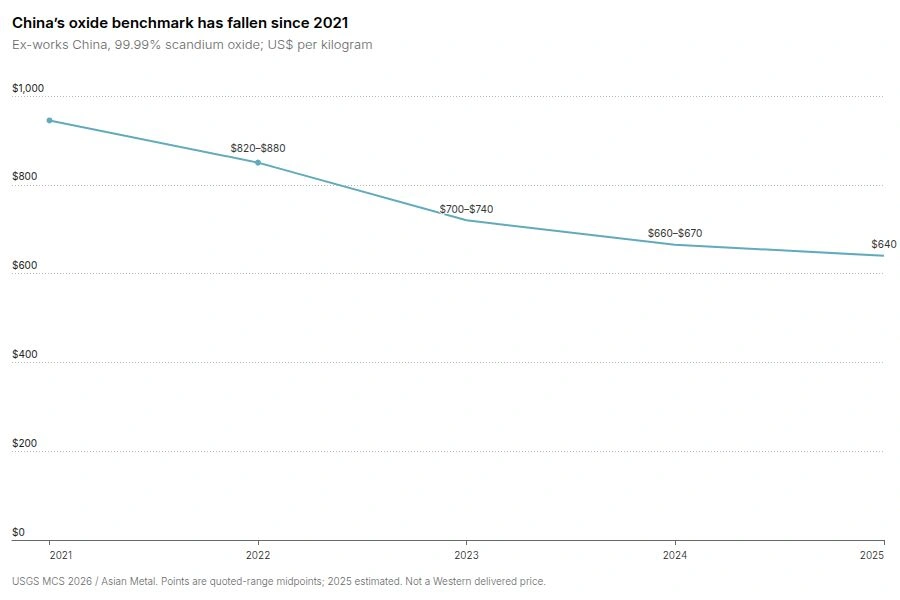
A falling price in China says little about what a Western buyer will pay, or whether they can buy at all.
Who needs it: AI data centres and defence
A major source of potential growth is AI infrastructure, through Bloom Energy. Data centres need large amounts of power, and grid connections can take years. Bloom sells on-site fuel cells using natural gas or hydrogen; scandium oxide is a dopant in their ceramic electrolyte. In April 2026, Bloom announced that Oracle intended to procure up to 2.8 gigawatts under an expanded agreement. Bloom says it believes itself to be the world’s largest buyer, but the precise share of global supply it purchases is not independently established here.
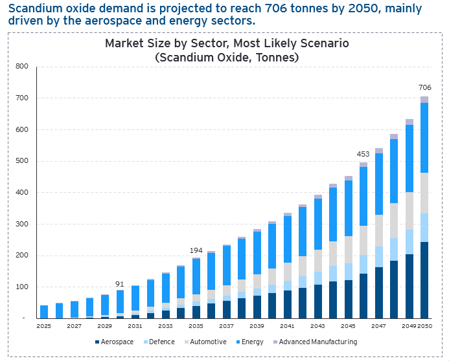
If Bloom keeps growing, demand could increase substantially. The Oregon Group cites an industry estimate of around 200 tonnes of scandium oxide annually for Bloom by the early 2030s. Hunterbrook, which disclosed a short position in Bloom, models roughly 220 tonnes under a Wall Street growth scenario. A separate EY-Parthenon study commissioned by Scandium Canada projects global demand of 194 tonnes a year by 2035. These are different scenarios, with different scopes and assumptions: the Bloom estimates are not components to add to the global forecast.
Defence is another important source of potential demand. On 4 August 2026, Lockheed Martin and NioCorp announced a non-binding memorandum of understanding for potential purchases of up to 15 tonnes a year of scandium oxide, supplied as oxide or aluminium-scandium alloy, over ten years. That annual ceiling equals a quarter of USGS’s estimated 2025 global consumption. A definitive agreement and actual deliveries are not assured.
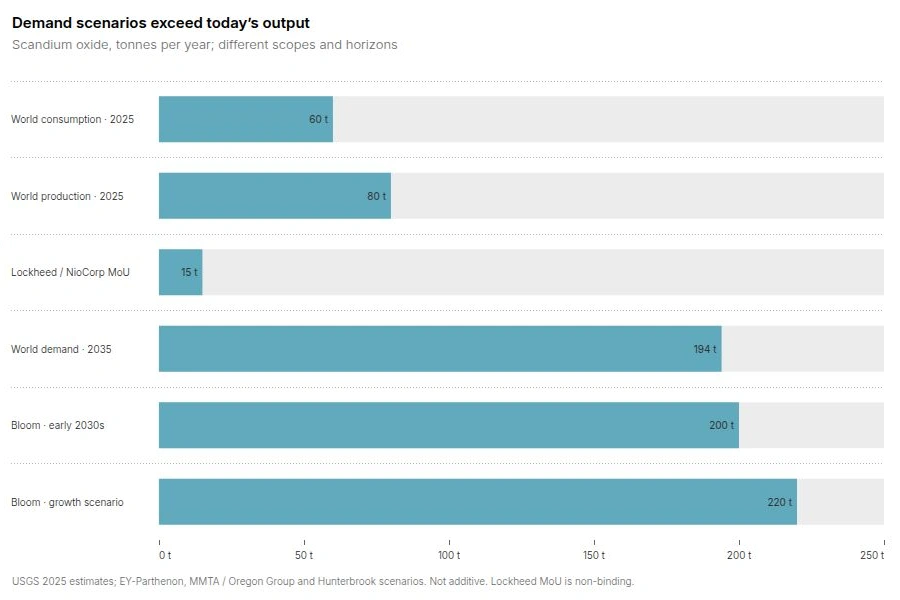
The three longer-term scenarios exceed 2025 output, but they are not confirmed orders or a consistent forecast of one future market. Actual demand depends on equipment deployment, material intensity, substitution, prices and supply contracts.
Does Bloom Energy get its scandium from China?
Bloom says it is not dependent on China. Hunterbrook alleges China-linked supply. Bloom has not publicly named the suppliers in the cited explanation, so the article cannot independently reconcile the two accounts.
Bloom's side: in July 2026 its chief operating officer wrote that Bloom recovers scandium from the waste of titanium, nickel, cobalt and uranium processing. It buys from several suppliers in several countries and says its current supply could support up to 25 gigawatts of fuel cells a year without relying on China. Bloom also believes it is the world's largest buyer of scandium (Bloom Energy). It repeated in a filing to US regulators that its supply does not depend on China (Mining.com).
The other side: on 8 July 2026, research firm Hunterbrook, which is betting on Bloom's share price falling, published a report claiming Bloom still relies on Chinese scandium. Using trade records and conversations with suppliers, it described four routes. One was scandium shipped straight from Hunan Oriental Scandium in China to Bloom's factory in Delaware. The others ran through middlemen in Thailand, Japan and South Korea (Hunterbrook; Webull). A Bloom shareholder has since filed a class action in California based on the report (Bloomberg Law). Bloom calls the claims false, and none of them has been tested in court.
For scandium investors, this dispute illustrates the importance of distinguishing a company’s supply assurances from independently verified, accessible supply. If China-linked routes are material, licensing is a risk; if Bloom has secured substantial non-Chinese supply, other customers may face tighter availability. Neither possibility proves a particular near-term shortfall or the volume available to competitors.
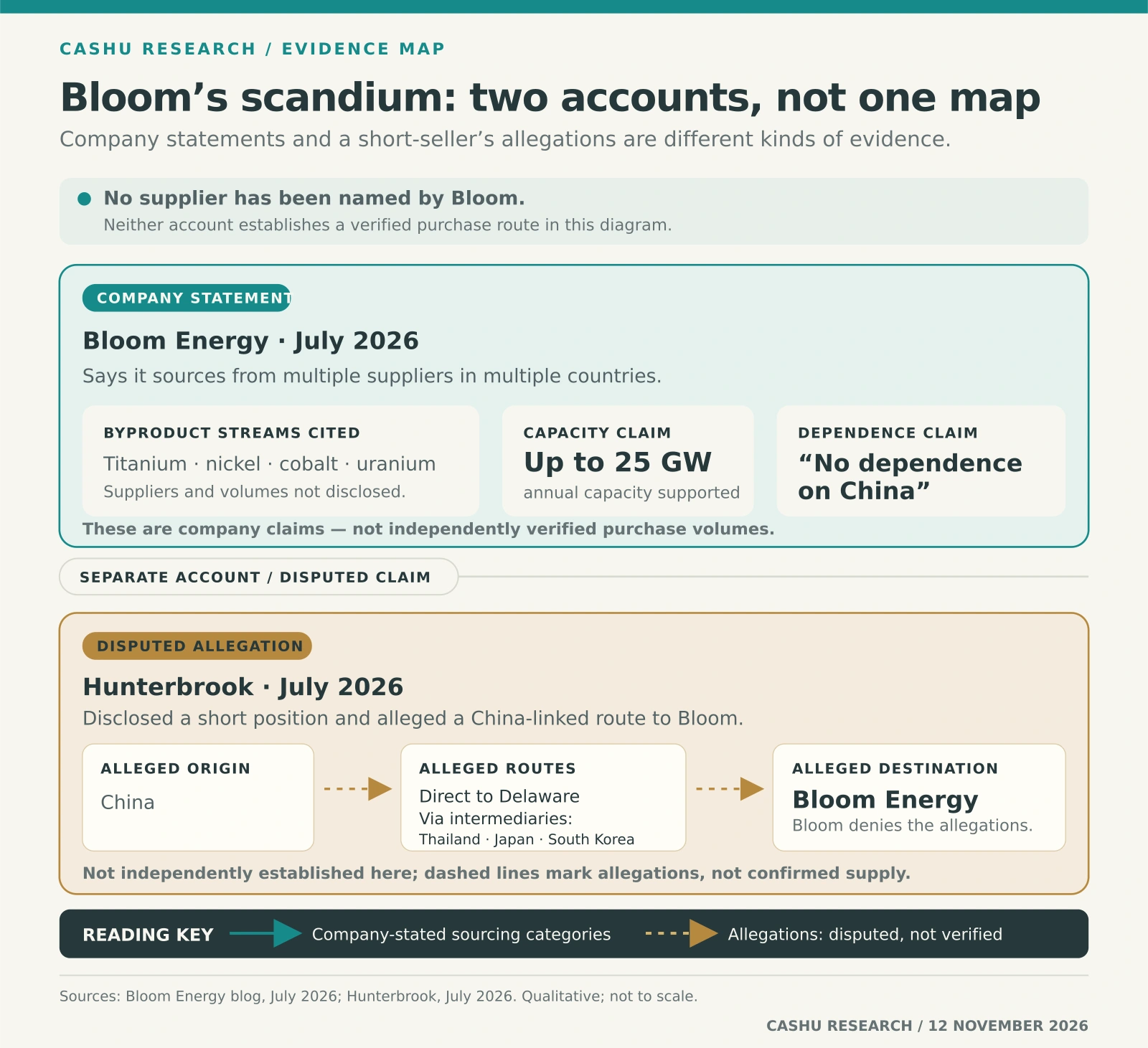
AI data centres and defence contractors are now drawing on the same small pool of supply.
New supply outside China
Several Western operations and development projects could diversify supply, but their capacities are at different stages. Four selected disclosed capacities total 147.5 tonnes of scandium oxide per year, including an expansion target at an existing operation. That total is not all new supply, not a common start-date forecast and not an exhaustive inventory of potential sources.
One of the more advanced Australian projects is Sunrise Energy Metals (ASX: SRL) and its Syerston deposit in central New South Wales. The March 2026 feasibility study describes 60 tonnes of scandium oxide a year over 32 years at forecast life-of-mine C1 cash operating costs of US$534/kg. Those are study estimates, not realised operating costs. The Pentagon’s conditional US$400 million loan commitment remains subject to financial close and other requirements and includes a right of first offer on output, not an unconditional purchase contract. The March study targeted mid-2028 production, while subsequent commentary cited late 2028 and A$450–475 million of development spending. Treat timing and costs as dated estimates, not a delivery commitment. The reported mineral-resource grade is about 414 ppm Sc.
Other projects are at different stages. Scandium International’s Nyngan design contemplates about 38.5 tonnes of scandium oxide annually; it has a mining licence, but financing and commercial execution remain necessary. Rio Tinto’s Burra project in NSW has potential output of up to 40 tonnes a year and remains in environmental studies and permitting. Sumitomo has indicated expansion plans without a quantified volume. Scandium Canada’s Crater Lake in Quebec and NioCorp’s Elk Creek in Nebraska are other proposed sources.
Several prospective Australian sources are concentrated in New South Wales. New capacity depends on permits, funding, construction and customer qualification; a government right of first offer is not evidence that all output has been sold. Mount Ridley is a possible additional source, not a proven substitute for these more advanced projects.
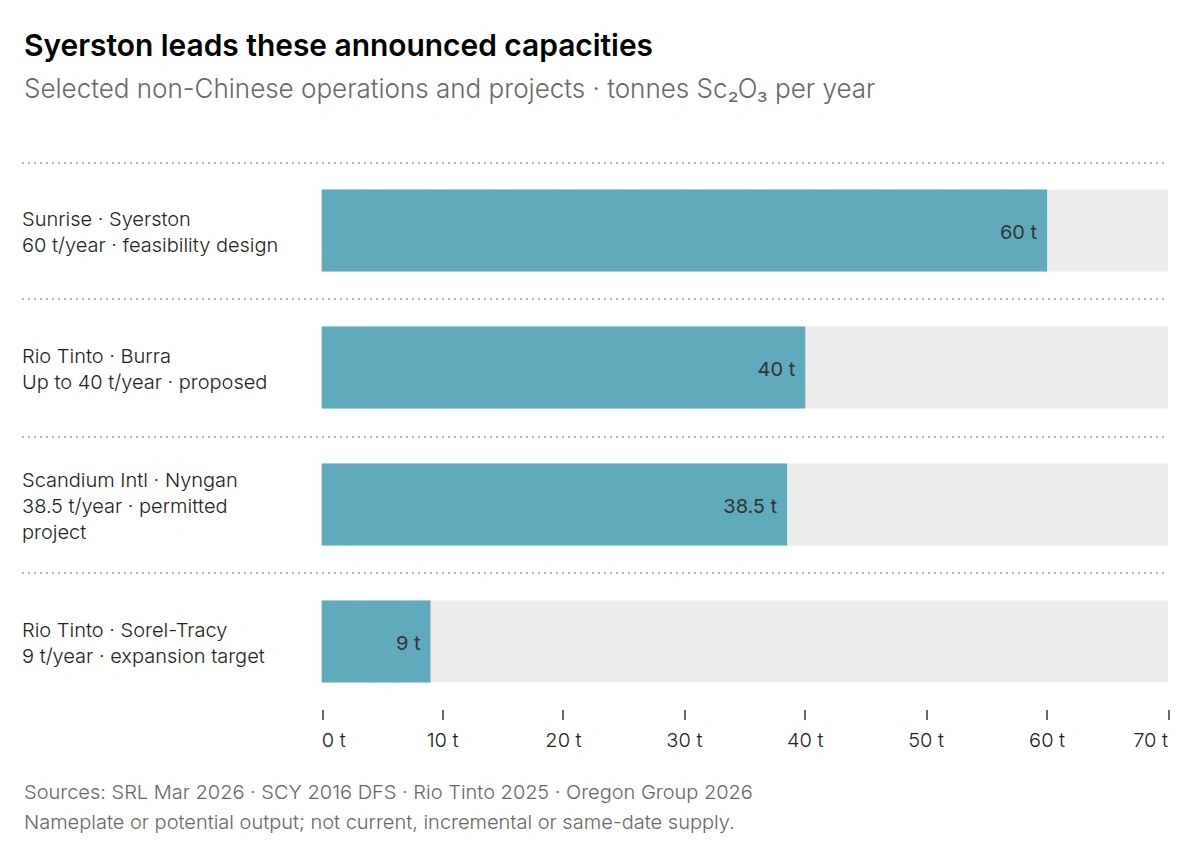
Sunrise is studying a larger 180 tonne a year version of Syerston, and Sumitomo plans to grow. Neither has a funded timeline yet.
Where Mount Ridley fits
Relationship disclosure: Cashu Research has been commissioned by Mount Ridley Mines (ASX: MRD) to provide research.
Mount Ridley’s Grass Patch project lies near Esperance in Western Australia. Its 26 August 2026 announcement reports 946 million tonnes at 50.1 ppm Sc, containing 47,357 tonnes of scandium metal, entirely in the Inferred category. The company describes this as the largest publicly reported JORC 2012 scandium resource. Its scale is notable, but contained metal is not a reserve, a production forecast or a measure of recoverable product. It should not be divided directly by annual oxide production to imply mine life.
The resource may get bigger. Mount Ridley has been re-testing old drill samples, and the latest batch found scandium up to 8 km outside the current resource boundary. An updated estimate is being prepared (Mining.com.au). The same ground also holds separate resources of heavy rare earths and gallium, both of which China also controls.
The catch is grade. Syerston has about 414 grams of scandium per tonne of rock. Grass Patch has about 50. So Mount Ridley's case rests on size, soft clay ore close to the surface, the extra metals that come with it, and being able to extract the scandium cheaply.
That last point is what Selectro is intended to address. Mount Ridley’s patent-pending process recovered 91.8% of scandium and an average 84% of heavy rare earths in reported laboratory tests on selected Grass Patch feed. The company reported low-temperature, atmospheric-pressure conditions and lower reagent use than earlier tests. Third-party bauxite and titanomagnetite tests also reported high gallium and vanadium recovery, opening a possible licensing route. These remain small-scale results; flowsheet development, product qualification, scale-up, capital and operating costs are not established by recovery percentages alone.
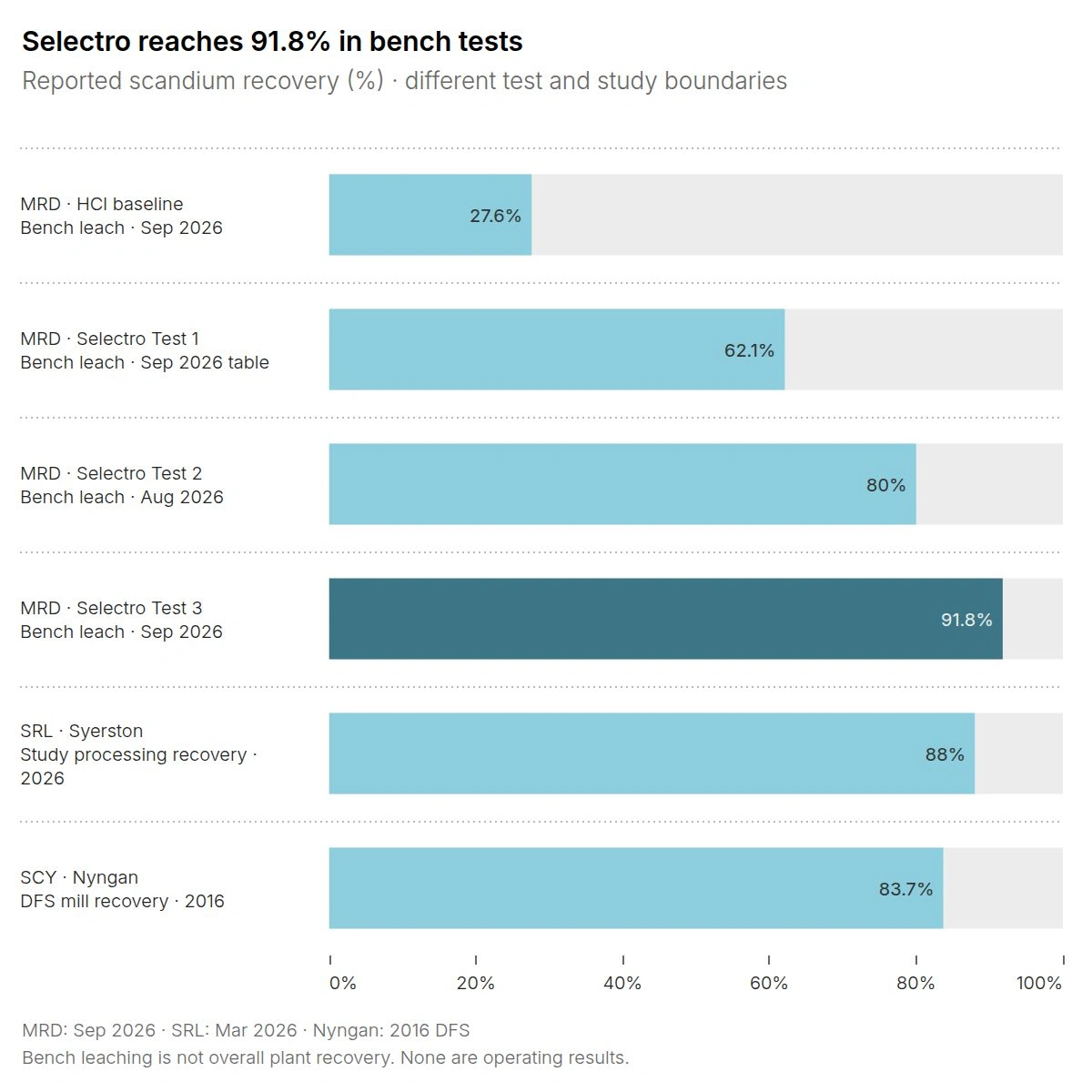
Recovery sources: MRD, 17 September 2026, comparative Table 2; SRL, 3 March 2026, study design parameters; Nyngan DFS, 18 April 2016.
The supplied November 2026 market snapshots value Sunrise at around A$1.95 billion and Mount Ridley at around A$60 million, sourced to Stockopedia and InvestSMART respectively. These are dated, approximate figures, not live quotes. Syerston’s higher grade, predominantly Measured and Indicated resource, detailed studies and conditional US financing distinguish it materially from Grass Patch. Comparing contained tonnes with whole-company market values is not a project valuation, a price target or evidence that the stocks should trade at the same multiple.
If Selectro works at larger scale and more drilling firms up the resource, Grass Patch could become a second major Australian source of scandium for buyers who want to avoid China.
What could go wrong
Grade and certainty. Grass Patch is low grade, and its whole resource is in the "Inferred" category, the lowest level of confidence under Australian reporting rules. More drilling and testing is needed to firm it up.
Scaling up. Selectro's results come from small lab tests on selected samples. The company itself says they don't yet prove the process will be profitable at full scale. A demonstration plant still has to be designed, costed and paid for.
The market. Scandium is traded privately and in small amounts, so prices are hard to see. China could ease its export rules. Bloom says it has developed alternatives to scandium it could switch to. The demand forecasts in this article are estimates, and the Lockheed deal is not binding.
Money and time. Mount Ridley is an exploration company and will need to raise more money to fund studies and a pilot plant. Sunrise is several years ahead on permits and financing.
Sources
U.S. Geological Survey, Mineral Commodity Summaries 2026: Scandium, February 2026
U.S. Geological Survey, Mineral Commodity Summaries 2025: Scandium, January 2025
The Oregon Group, Scandium: can new supply keep pace with defence and AI?, 12 October 2026
Crux Investor, Pentagon Puts $400M Behind Scandium as a 70-Tonne Supply Gap Opens, 10 August 2026
Bloom Energy, Demystifying Scandium Oxide: Why It Matters in Bloom Fuel Cells, 7 July 2026 (updated 20 July 2026)
Hunterbrook, Bloom's Big Lie, July 2026 (author disclosed a short position in Bloom Energy)
Mining.com / Bloomberg, Bloom Energy criticism spotlights obscure but vital rare mineral, July 2026
Webull, Bloom Energy hit by short report questioning China-free supply claims, July 2026
Barchart, A short seller report says China could kill this key data center supplier's growth, July 2026
Bloomberg Law, Bloom Energy investor sues over short seller's China accusations, 31 July 2026
Sunrise Energy Metals, Syerston Feasibility Study, ASX announcement, 3 March 2026
Mining.com, Friedland-backed Sunrise Energy doubles scandium resource in Australia, September 2025
Mount Ridley Mines, Scandium Resource Upgraded to 946Mt at the Grass Patch Project, ASX announcement, 26 August 2026
Market Open, Mount Ridley Mines upgrades Grass Patch scandium resource, August 2026
Bulls N' Bears, Mount Ridley Mines grabs global scandium crown with 946Mt WA resource, August 2026
Mining.com.au, Mount Ridley extends scandium beyond Grass Patch resources, 23 September 2026
Cashu Research via GlobeNewswire, China Controls 99% of Gallium. Mount Ridley Mines (ASX: MRD) May Have Found the West's Solution, 21 October 2026
Discovery Alert, Mount Ridley Hits 95.5% Vanadium Recovery in Test With No Roast, November 2026
Stockopedia, Sunrise Energy Metals share price and market capitalisation, accessed 12 November 2026
InvestSMART, Mount Ridley Mines share price and market capitalisation, prices as at 6 November 2026
Disclosure
This article was prepared by Cashu Research, the research division of Cashu Technologies Pty Ltd, a Corporate Authorised Representative (AR No. 001318029) of Adviser Solutions Group Pty Ltd (AFSL 485946). Mount Ridley Mines Limited is a paying client of Cashu Group, and Cashu Research's coverage of Mount Ridley is commissioned and paid for by the company. This article is general information only. It does not take into account any person's objectives, financial situation or needs and is not a recommendation to buy, sell or hold any security. Forward-looking statements and third-party forecasts are inherently uncertain. Readers should consider their own circumstances and seek professional advice before making any investment decision.
Additional primary-source checks
- Rio Tinto / Canada Growth Fund, Sorel-Tracy expansion, 1 November 2025
- NioCorp / Lockheed Martin, non-binding MoU, 4 August 2026
- Office of Strategic Capital, Sunrise conditional loan commitment
Visuals: Original EY-Parthenon demand chart credited to Scandium Canada; other charts and explanatory diagrams rebuilt by Cashu Research from the supplied draft and cited sources. Header image is an AI-generated conceptual illustration of advanced materials, not a photograph of scandium samples, a company facility or a project site.