Cashu Group receives fees from Savana Asset Management for investor awareness and marketing services. This article is not independent research. Cashu Group, its directors, employees and associates may hold units in SVNP. See the full disclosures below.
Every major index is now a bet on a handful of stocks. In Australia it is four banks; in the US it is the AI build-out. We think that makes this a stock picker's market, and the Savana US Small Caps Active ETF (ASX: SVNP) is one of the purest stock-picking vehicles on the ASX: 25 to 50 undervalued US companies, equal-weighted, with no mega-cap and no index to hide behind.
The case in one paragraph
Passive investing works when the index is diversified and fairly priced. Today the big indexes are neither. A quarter of the ASX 200 is four banks trading 35–55% above their own long-run multiples. The top ten stocks are about 39% of the S&P 500, and ING estimates tech investment now drives roughly a third of US economic growth. Buy the index and you buy that concentration at whatever price it trades. Underneath, the US small-cap market is the largest pool of under-researched listed companies in the world, with valuation gaps wide enough that what you own matters far more than how much market you own. That is exactly where SVNP fishes, and since its strategy launched two years ago it has beaten its benchmark by 4.4 points a year.
The problem with owning the index
Buy the ASX 200 and 24% of your money goes into four businesses that all lend against the same Australian houses. Add Macquarie and the miners and you are close to 60% in two sectors. Information technology is under 2%. That is not diversification; it is a single macro bet with a dividend attached.
The bet is expensive. CBA trades on about 25.5x earnings against a ten-year median near 16.5x, and NAB, ANZ and Westpac sit 35–52% above the sector's 20-year average. In our recent note, The Bank Trap, we showed that if the Big Four simply revert to their own long-run multiples, the ASX 200 loses about 860 points, close to 10%, with earnings unchanged.
Passive money can't step around that. Active money can. An index fund has to buy CBA at whatever price CBA trades. A stock picker can decline.
It isn't just Australia
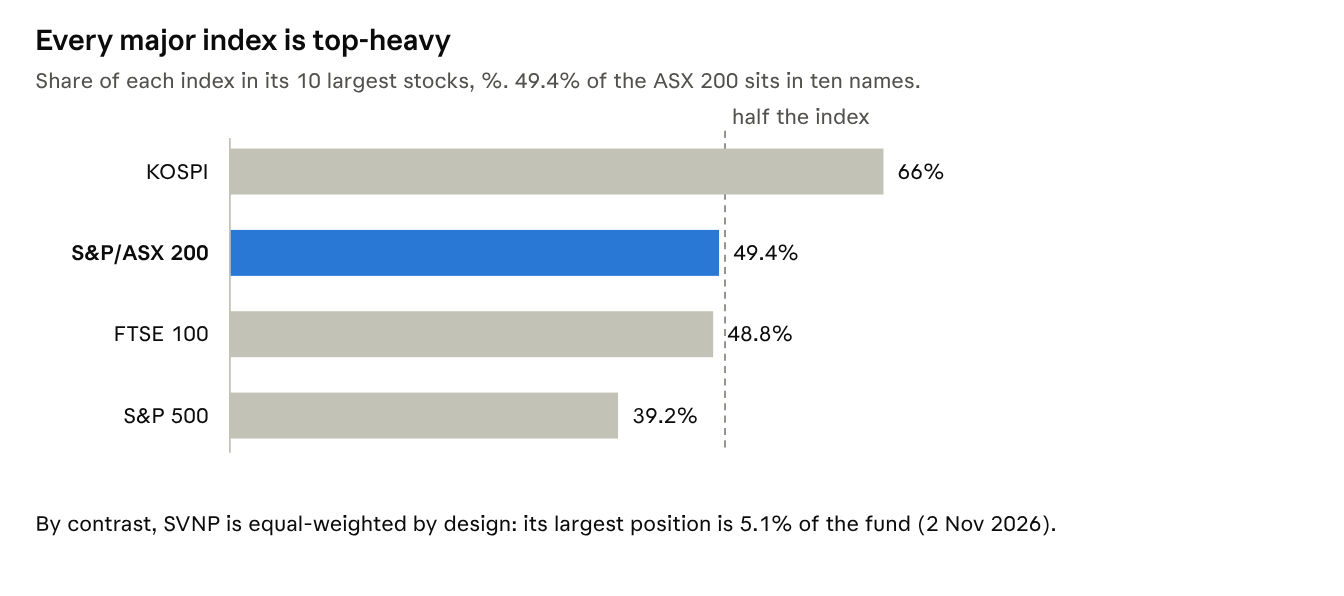
Shifting from Australian to global index funds swaps one crowded trade for another. Half the ASX 200 is in ten stocks, and so is half the FTSE 100. The S&P 500 is at its most concentrated in decades, with the top ten near 39%, almost all of them riding the same AI investment cycle.
The AI build-out is now carrying the US economy. J.P. Morgan estimates the major US technology companies will spend close to US$800 billion on capital expenditure in 2026, about ten times what they spent in 2019, and the Federal Reserve puts AI-related investment at roughly 1.4 percentage points of annualised US GDP growth in the March quarter. The OECD estimates three-quarters of global AI venture capital went to US companies in 2025. That spending has pushed index money into a narrow set of chipmakers and hyperscalers on full valuations and left a long tail of profitable, cash-generating companies unwanted. When an entire benchmark leans one way, the opportunity sits in what it is ignoring. That tail is SVNP's hunting ground.
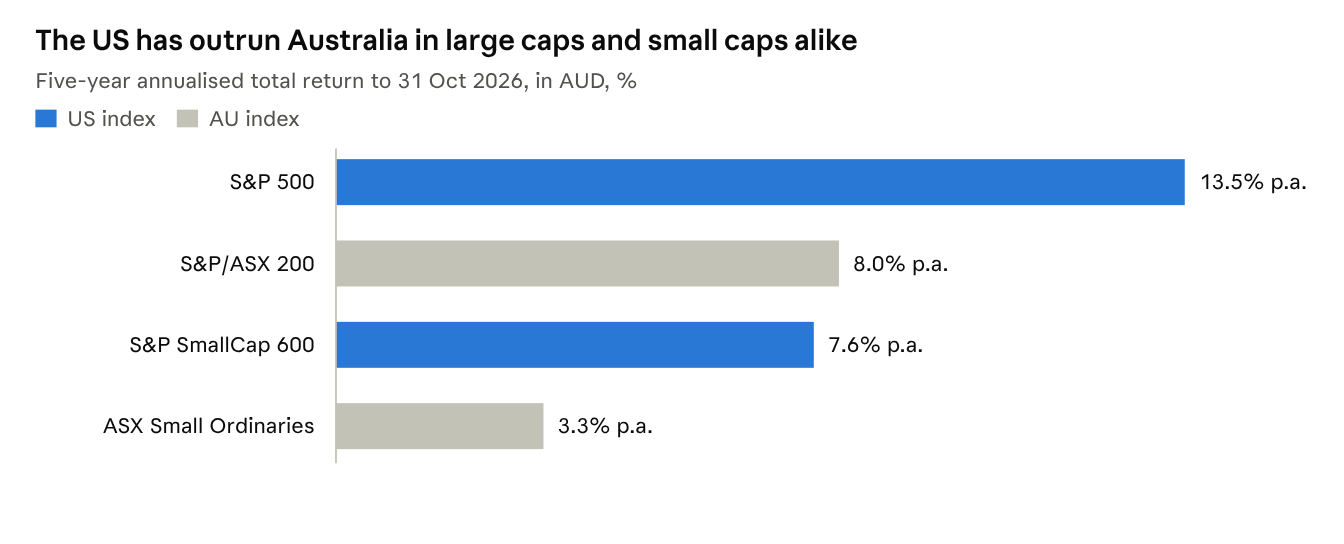
And the gap between the two economies is widening, not closing. Savana's October letter makes the case in numbers. US labour productivity is up 5.3% since March 2024 while Australia's has gone backwards. The US economy grew at a 3.4% annualised rate in the September quarter and the IMF has it at 2.3% in both 2026 and 2027, against 1.9% and 1.6% for Australia. Consensus has S&P 500 earnings growing 35% this calendar year and S&P SmallCap 600 earnings 31%; the ASX 200 is forecast at 12.7% after two years of falling earnings, and the Small Ordinaries at under 9% cumulative across 2026 and 2027 combined. Over the long run, share prices follow earnings, and the earnings are in the US.
Who Savana is
SVNP is an active ETF, traded on the ASX like a share, that holds only US small caps. It is managed by Savana Asset Management (trading as Savana Active ETFs, AFSL 700458), with K2 Asset Management as responsible entity. The fund itself dates to January 2022, when it was the Fat Prophets high-conviction fund; the current US small-cap strategy has run since 6 November 2024.
| Benchmark | S&P SmallCap 600 Total Return (AUD) |
|---|---|
| Holdings | 25–50 stocks, broadly equal-weighted |
| Universe | US-listed, minimum US$500m market cap, liquidity screens |
| Rebalance | Generally every two months |
| Currency | Unhedged AUD |
| Fees | 1.00% p.a. management; 15% performance fee over benchmark, high-water mark |
| Distributions | Semi-annual |
| Funds under management | A$6.5m (2 Nov 2026) |
Source: Savana fund page and PDS.
For an Australian investor, SVNP does two jobs at once. It moves money out of a bank-heavy home market into the US, and inside the US it avoids the mega-cap tech names that dominate the S&P 500. It is the anti-index on both counts.
How Savana picks stocks
Savana's engine is built to find companies trading below intrinsic value, and to stop humans from overriding it. Its algorithms screen thousands of US companies, and its documents describe combining "a large number of independent valuation estimates" into one view using what it calls "complex systems theories and collective intelligence". In plain terms: many valuation methods vote, the consensus decides, and no single model or manager's hunch dominates. Associate director Samuel Atkinson has said the team tries not to intervene "unless there's fraud or an error in the data".
The edge Savana is after is behavioural, not informational. Presenting at the ETF Evolution 2026 Summit in Sydney, the team cited S&P data showing 89% of Australian equity general funds underperformed their benchmark over 15 years, then set out why they think a systematic process can beat those odds. Markets are mostly efficient because millions of independent judgements average out. The opportunity comes when that independence breaks down and investors herd, so prices overshoot in both directions. Savana's process is built on four things: find information the market is ignoring rather than information it does not have, interpret it differently, act before the consensus shifts, and do all of that through a system that repeats it without fear or greed.
Everforth is the worked example. The US IT services company (NASDAQ: EFOR) fell more than 50% in a day on a weak quarter in May 2026. Savana's algorithms flagged it as undervalued and the fund bought at US$20.32 on 8 May. When earnings recovered the following quarter the rules-based rebalance sold at US$30.92 on 8 September, a 52% gain in four months. One stock does not make a track record, but it shows the mechanism: the market extrapolated a bad quarter into a broken business, and the system did not.
The result is a portfolio that looks nothing like the benchmark on price. At the June 2026 fact sheet, SVNP's holdings traded on 10.5x trailing earnings against 32.1x for the S&P SmallCap 600, at 0.6x book against 2.2x, and at 2.7x cash flow against 21.2x. They also carried less debt (43% debt-to-capital versus 55%) and paid more than twice the dividend yield.
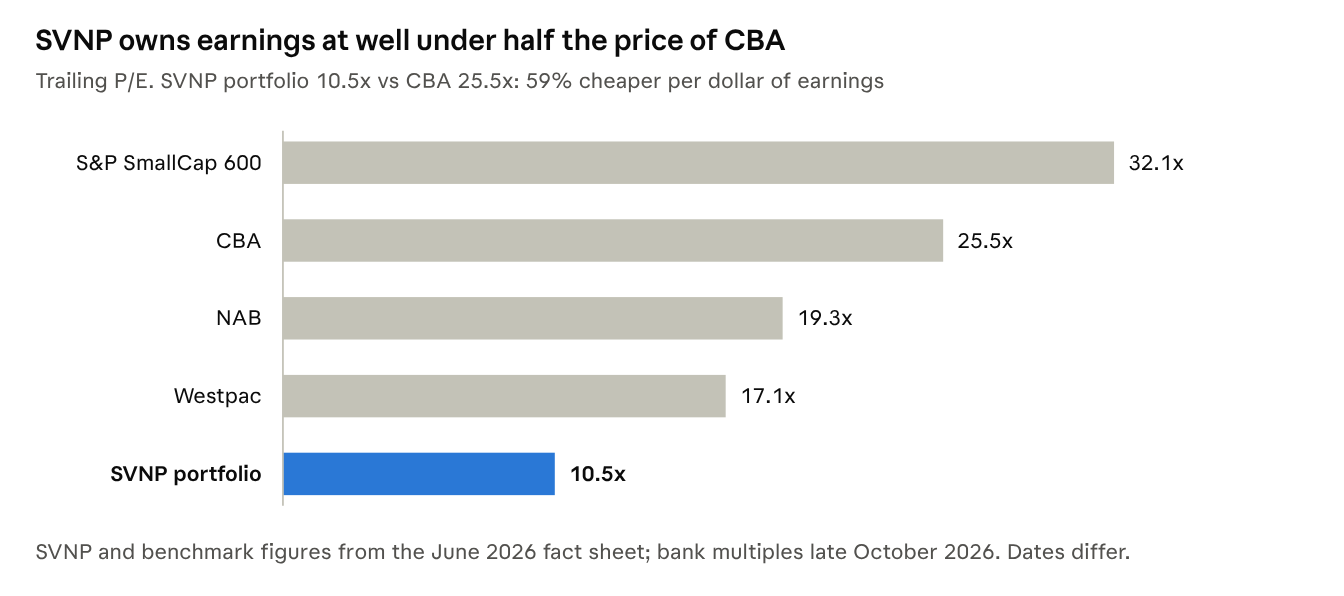
That is the stock picker's argument in one picture. An ASX 200 investor is paying 25x for CBA's 7% earnings growth because the index says so. SVNP is paying about 10x for companies the market has stopped looking at, on the view that some of them are mispriced and will re-rate. It does not need all of them to be right.
Inside the portfolio
SVNP's five largest positions make up approximately 23% of the fund and cover five unrelated businesses. The ASX 200's four banks make up 24.4% and cover one.
| Holding | What it does | Weight |
|---|---|---|
| Teladoc Health (NYSE: TDOC) | Virtual healthcare and chronic-care platform | 5.1% |
| DXC Technology (NYSE: DXC) | IT services and outsourcing | 4.9% |
| Kohl's (NYSE: KSS) | US department-store retailer | 4.7% |
| MidCap Financial Investment Corp (Nasdaq: MFIC) | Lender to US mid-market companies | 4.1% |
| Enovis (NYSE: ENOV) | Orthopaedic and medical devices | 4.1% |
Top five as at 31 October 2026, per Savana's October 2026 Letter to Investors.
Each of these is a name the market had given up on, which is the point. Teladoc and Enovis are healthcare businesses de-rated through the rate cycle. DXC and Kohl's are classic "broken stories" priced for decline. MFIC trades as a high-yield credit vehicle. Savana's engine is not asking which of these is exciting; it is asking which ones are priced below what they are worth.
October showed what happens when the market changes its mind. Teladoc rose 46.7% in the month around its third-quarter result, DXC gained 38.3% on reports of a potential US$2.4 billion sale of its insurance software arm, and Kohl's added 31.7% on better consumer data. The same month, China Yuchai, Terra Innovatum and Prospect Capital fell 21–35% with no single event to explain it, and the fund finished the month down 2.5%. Savana notes that dispersion in the S&P 500 in October was above the 95th percentile of history. For a stock picker, that is the environment that creates the opportunities, not the one that closes them.
The portfolio turns over, and the sector mix moves with the opportunity. At the end of June the top five were Insight Enterprises, MasterBrand, ScanSource, Kohl's and ManpowerGroup, and technology and consumer stocks were 55% of the fund. By November, financials had grown to 42%, including mid-market lenders such as MFIC. That is what a bottom-up process looks like: sector weights are an output, not a target. It is also a reminder that SVNP is not a "no financials" fund; it simply owns the ones it thinks are cheap, rather than the ones the index tells it to.
A track record that has already paid
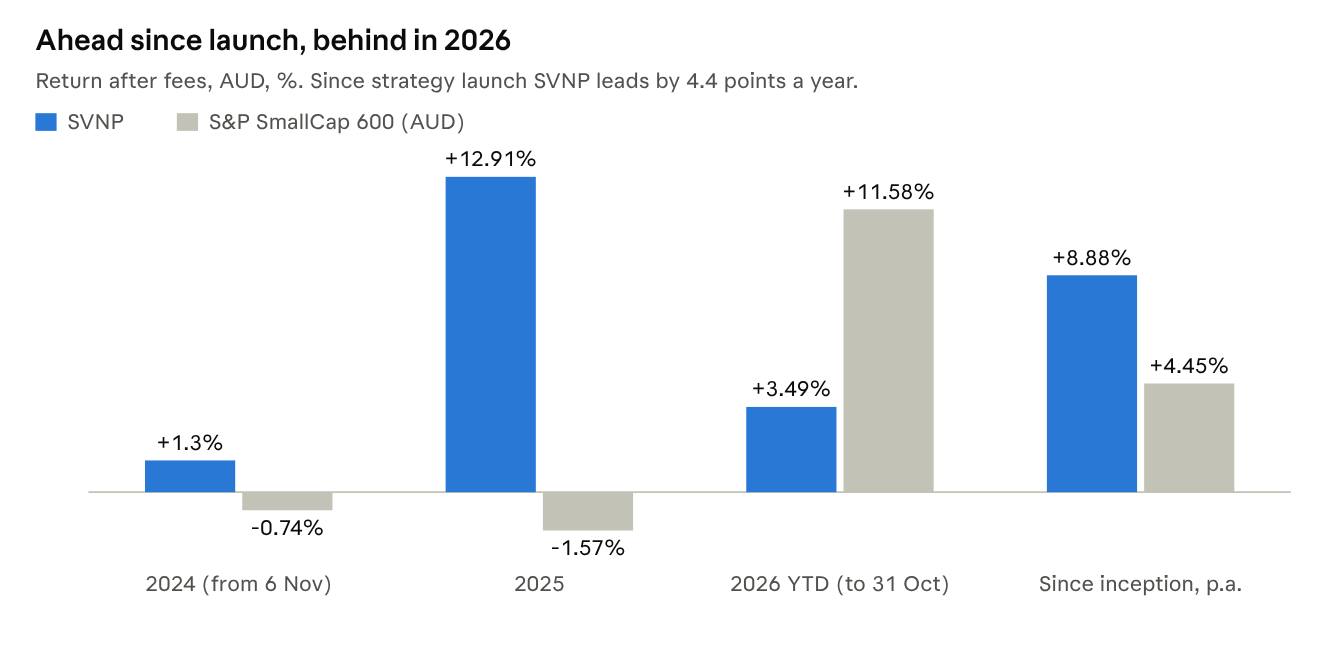
Two years in, the process has delivered. Since the US small-cap strategy began in November 2024, SVNP has returned 8.9% a year after fees against 4.5% for its benchmark; A$10,000 invested at launch was worth about A$12,000 at the end of October against about A$11,000 in the index. In 2025 it beat the S&P SmallCap 600 by 14.5 points, a year in which the benchmark went backwards.
2026 is the setup, not the verdict. SVNP is up 3.5% this year to 31 October against 11.6% for its benchmark, because small-cap leadership has come almost entirely from AI and semiconductor names, the expensive stocks a valuation process is built to avoid. The upside of that lag is that the gap between what SVNP owns and what the market is chasing has widened. Its holdings were on about 10x earnings at June while the benchmark was on 32x. If leadership broadens beyond the AI trade, that spread is where we would expect the catch-up to come from. This is how stock pickers make money: buying when the price gap is widest, not after it has closed.
Investors have been paid for the volatility. At June, SVNP's annualised volatility since inception was 26.4% against 21.8% for the benchmark, partly because 25–50 equal-weighted stocks will always move more than 600. Its Sharpe ratio was still higher (0.56 versus 0.35), meaning investors were paid for the extra volatility. SVNP is an active ETF with a market maker, which is intended to support trading close to net asset value. Units can still trade at a premium or discount, particularly in stressed or illiquid markets.
What investors should weigh
Cheap can stay cheap. Value-driven small-cap portfolios can lag for long stretches when markets chase growth, as 2026 shows. Concentration cuts both ways: with 25–50 stocks, one bad call such as a retailer missing earnings or a lender's credit souring shows up in the fund's return. The model is the manager. Savana deliberately limits human override, so investors are trusting a system whose valuation inputs are not publicly detailed. Currency is unhedged, so a stronger Australian dollar reduces returns in AUD. The fund is small, at about A$6.5m, and the current strategy has a two-year record. Fees are higher than passive: 1% a year plus a 15% performance fee over the benchmark. These are the trade-offs that come with owning something that does not look like the index, and the reason the opportunity exists in the first place.
Sources and disclosures
Sources. Fund details, holdings, sector weights and performance to 2 November 2026: Savana fund page. Portfolio fundamentals, risk statistics and June holdings: SVNP fund fact sheet, June 2026. Strategy, valuation methodology and risks: SVNP Product Disclosure Statement. Performance to 31 October 2026, top holdings, sector weights, October stock moves, US–Australia comparison (S&P Global, J.P. Morgan, Federal Reserve, OECD, IMF, ABS, BEA), ETF Evolution 2026 presentation and the Everforth example: Savana Letter to Investors, October 2026 (Issue 15). Savana commentary: Money Management, 8 Jul 2025. 2026 performance context: Business News Australia. US tech investment share of GDP growth: ING via IndexBox, 20 Aug 2026. Index concentration: WhichIndex ASX 200, FTSE 100, KOSPI, ChartRow S&P 500, ECM Source. Bank multiples: as cited in The Bank Trap. Prepared by Fox Slotemaker, Research Manager, Cashu Research.
Commercial relationship disclosure. Cashu Group has a commercial relationship with Savana Asset Management Pty Ltd, the investment manager of SVNP, and receives fees from Savana for investor awareness and marketing services. Readers should treat this note as promotional content prepared in the context of that relationship, not as independent research. Cashu Research retains editorial control over the content, and the figures and opinions in it are drawn from Savana's published materials and public sources as cited. Cashu Group, its directors, employees and associates may hold units in SVNP.
General advice warning. This report has been prepared by Cashu Research, a division of Cashu Technologies Pty Ltd, Corporate Authorised Representative (AR No. 001318029) of Adviser Solutions Group Pty Ltd (AFSL 485946). It contains general information and general financial product advice only and does not take into account the objectives, financial situation or needs of any particular person. Before acting on it, consider its appropriateness to your circumstances, read the SVNP Product Disclosure Statement and Target Market Determination, and seek independent professional advice. Past performance is not a reliable indicator of future performance. Cashu Research, its directors, employees and associates may hold positions in, or provide services to, securities and funds discussed in this report.