
Rhythm Biosciences (ASX: RHY) sells a simple blood test for bowel cancer in Australia, and an NHS research laboratory in England has completed the first step towards independently evaluating it. For a company of roughly A$22 million market value in the 5 November 2026 snapshot, that second fact is the one worth paying attention to.
A cancer that is beatable, if you find it in time
The numbers are blunt. Around 15,500 Australians are diagnosed with bowel cancer each year and about 5,350 die from it, which works out to roughly 100 deaths every week. It is the country's second deadliest cancer. Caught early, around nine in ten people survive. Caught late, that falls to about one in ten.
Screening exists, but most people don't use it. Every two years the National Bowel Cancer Screening Program mails a free stool test kit to Australians aged 50 to 74. The latest AIHW monitoring report shows only 42% of the 6.4 million people invited in 2023–24 actually did the test. Put another way, nearly six in ten kits go unused. People aged 45–49 are also eligible and can request a free kit; automatic mailing generally starts at 50.
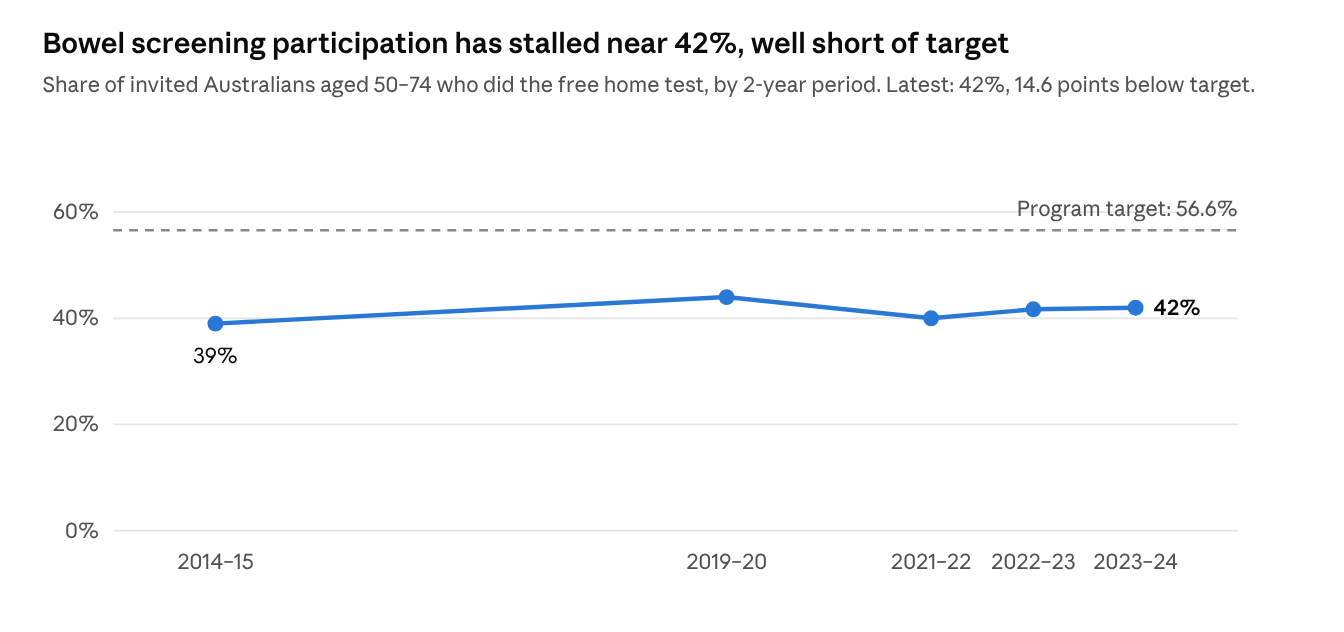
Source: AIHW National Bowel Cancer Screening Program monitoring reports 2024–2026
And the disease is getting younger. The AIHW estimates around 2,000 Australians under 50 were diagnosed in 2024, more than double the number in 2000, and about one in eight of all cases. Many are below the age for automatic kit invitations, although people aged 45–49 can request a kit. They tend to turn up at a GP with symptoms, often at a later stage.
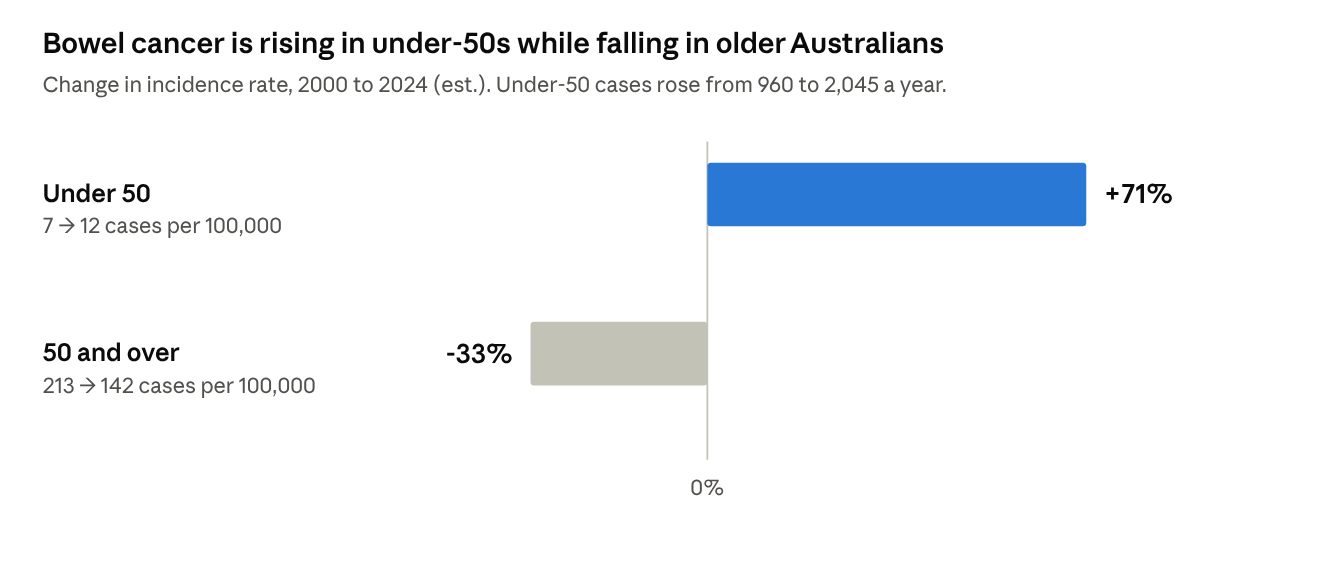
Source: AIHW, An overview of colorectal cancer in Australia (2021–2024 projected)
What ColoSTAT does
A blood draw instead of a stool sample. ColoSTAT measures five proteins linked to bowel cancer in a single blood sample. An algorithm combines those readings with the patient's age and sex to produce a likelihood score. The science traces back to CSIRO research.
It is aimed at people with symptoms, not mass screening (yet). The first job for ColoSTAT is triage. When someone sees a GP with bowel symptoms, the usual next step is a colonoscopy. Colonoscopies cost A$1,000–$4,500 each, involve waiting lists, and in symptomatic patients most of them find no cancer. A blood test that flags who is more likely to have cancer could help doctors prioritise.
It is also a quiet answer to the participation problem. People who won't do a stool kit at home are often perfectly happy to give blood at a pathology collection centre. That convenience is the long-term pitch.
The evidence so far
Around 90% sensitivity in company-reported validation data. The current, second-generation test detected about 90% of bowel cancers in validation work on more than 300 clinical samples, with consistent results across stages I to IV. Publication of the study behind that figure remains pending at the time of writing; these results should not be treated as established population-screening performance. A sensitivity of about 90% still means roughly one in ten cancers could be missed in the studied population. A negative result does not rule out cancer and should not delay appropriate clinical assessment.
The trade-off is false alarms. In the same data, ColoSTAT correctly cleared about 54% of people who did not have cancer. That is deliberate for a triage test: it is tuned to catch cancers, and people who test positive still go on to colonoscopy. It is also why the test is positioned as a filter before colonoscopy, not a replacement for it. Conversely, about 46% of people without cancer could test positive at that threshold. The proportion of positive results that actually represent cancer also depends on how common cancer is in the tested population.
There is peer-reviewed data behind the original version. A multi-centre trial of the first-generation test, published in the Journal of Gastrointestinal Cancer in January 2026, showed 81% sensitivity and 91% specificity against colonoscopy. The current multiplex test uses the same five proteins, re-engineered to be faster and cheaper to run.
Already on sale in Australia
From lab project to paid test in 2026. ColoSTAT was added to the scope of Rhythm's NATA-accredited laboratory in Parkville, Melbourne in March, and the company booked its first paid clinical test in the March quarter. It was later accepted onto the TGA's in-house IVD database, the standard pathway for tests run inside an accredited lab.
Doctors can order it, and patients can get to it. A distribution deal with 4Cyte Pathology gives access to collection centres across NSW, Victoria and Queensland on a per-test basis, with no upfront cost to Rhythm. GPs on one of Australia's major practice software platforms have been able to order ColoSTAT directly since August, with Best Practice integration targeted for November. Repeat ordering from the same doctors is starting to show up.
The economic case for government funding. An independent study by Value-Based Access, released in October, modelled GPs using ColoSTAT before referring to public hospital colonoscopy. The answer: a large cut in colonoscopies and a net saving well above the cost of testing. Rhythm plans to use this in an application to the Medical Services Advisory Committee, the first step towards a Medicare rebate. These are modelled outcomes, not savings already achieved: the study estimated 29,427 fewer public hospital colonoscopies and A$72.4 million in annual net savings. Results depend on the assumptions, clinical performance and uptake.
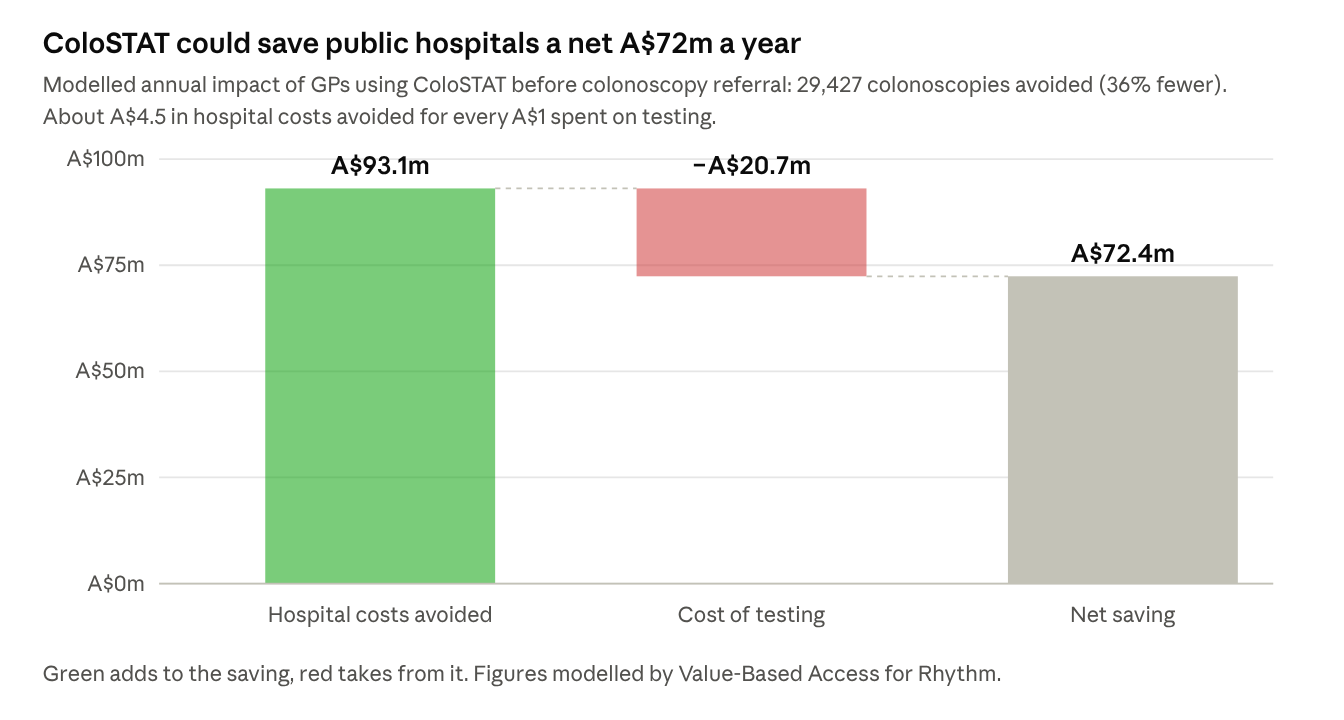
Source: Value-Based Access economic study, announced by Rhythm Biosciences 7 Oct 2026; testing cost derived as costs avoided minus net saving
The NHS is now running it
An NHS lab in Surrey completed technology transfer in September. The Southern Hub research laboratory at Royal Surrey NHS Foundation Trust in Guildford evaluates new diagnostic technologies. On 22 September 2026, Rhythm announced the Hub had completed technology transfer: its own staff could run ColoSTAT in their own laboratory using Rhythm's system and reagents. This first phase used supplied standards and controls, not proof of clinical performance in NHS patients.
Why that matters more than it sounds. This was Rhythm's first completed transfer of the assay to an independent laboratory. Showing an independent lab can set it up and run it to its own standards is a prerequisite for licensing the test to pathology labs overseas, which is how Rhythm plans to grow.
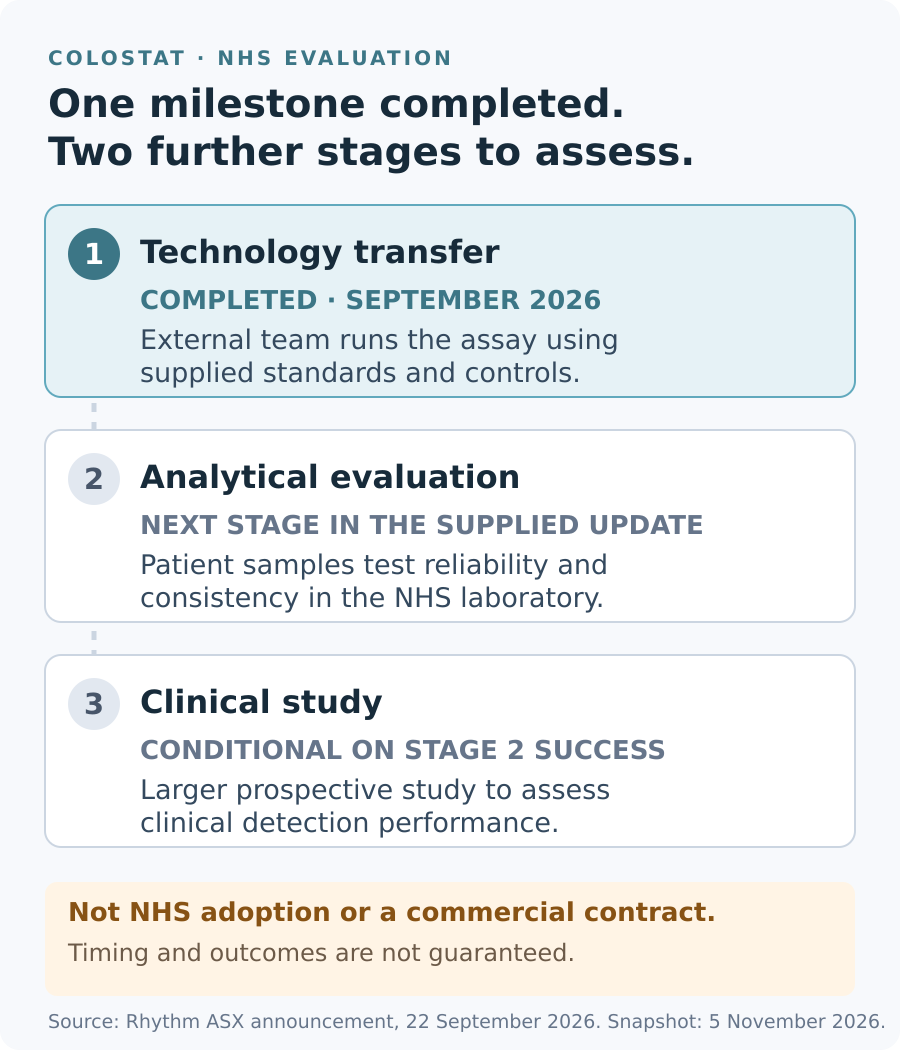
What comes next. The evaluation has three stages, and Rhythm has been clear that timing and outcomes are not guaranteed.
| Stage | What it involves | Status |
|---|---|---|
| 1. Technology transfer | NHS team sets up and runs ColoSTAT independently | Completed, Sep 2026 |
| 2. Analytical evaluation | Testing on real patient samples in the NHS lab | Next |
| 3. Clinical study | Larger study on how accurately ColoSTAT detects bowel cancer in an NHS setting | If stage 2 succeeds |
A good result would give Rhythm independent performance data from inside the NHS, which is the kind of validation international partners look for. Completing technology transfer is not NHS approval, routine NHS use or a commercial contract. The company says there is no certainty the later evaluation stages will succeed or lead to adoption.
Why investors should care
Australia is the proving ground, not the prize. Australia accounts for roughly 2% of global healthcare spending. Bowel cancer kills more than 900,000 people a year worldwide, and nearly every developed country runs a screening program with the same participation problem Australia has.
The model travels. Rhythm isn't trying to build labs in every country. The plan is to supply its system and reagents to established pathology labs and earn on each test. The NHS transfer demonstrates technical transferability outside Melbourne; it does not yet establish a successful overseas commercial model.
There is a second product in the drawer. Rhythm also owns geneType, a range of genetic risk tests for cancers including bowel, breast and lung. A geneType result can identify people at higher risk who might then be steered towards a ColoSTAT test, and geneType sales are already running in Australia, New Zealand, Southeast Asia and the US.
What to watch, and the risks
Near-term catalysts. Rhythm has flagged a busy end to 2026: ColoSTAT ordering through Best Practice GP software, more collection centres, a digital awareness campaign, first engagement with MSAC on Medicare funding, and patient-sample testing in the NHS lab. The AGM is in Melbourne later this month, and publication of the latest performance study is pending.
Funding is the big one. Test volumes and revenue are growing but from a very small base, and the company is still loss-making (an A$5.9 million loss in FY26). Its September quarter cash flow report pointed to roughly one quarter of funding at the current burn rate. Rhythm expects an R&D tax refund before year-end and is seeking approval for extra placement capacity at the AGM, so further capital raising and dilution are likely.
Other things that could go wrong. The NHS evaluation could take longer than hoped or fail to produce the result Rhythm wants. Medicare funding is a lengthy process with no guarantee. GP uptake of any new test tends to be slow, and ColoSTAT competes with established colonoscopy pathways and other blood-based tests in development globally. The share price has fallen sharply through 2026, reflecting these risks.
Sources
Rhythm Biosciences: NHS England ColoSTAT evaluation commences (ASX, 26 Feb 2026)
Rhythm Biosciences: ColoSTAT accredited clinical service (ASX, 9 Mar 2026)
Kalkine: Independent ColoSTAT study identifies potential public health savings (Oct 2026)
Kalkine Media: Runway check on Rhythm Biosciences (3 Nov 2026)
Stockhead: Rhythm completes final validation of ColoSTAT
AIHW: National Bowel Cancer Screening Program monitoring report 2026
AIHW: An overview of colorectal cancer in Australia
Bowel Cancer Australia: The facts
Disclaimer
This article is published by Cashu Research, a trading name of Cashu Technologies Pty Ltd, Corporate Authorised Representative (AR No. 001318029) of Adviser Solutions Group Pty Ltd (AFSL 485946). It contains general information only and does not take into account your objectives, financial situation or needs. It is not a recommendation to buy, sell or hold any security. Small-cap and early-stage healthcare companies carry high risk, including the risk of losing your entire investment. Cashu and its associates may hold, or have commercial relationships with companies mentioned. Do your own research and consider seeking professional advice before investing.
Medical context: this is an investment article, not medical advice. ColoSTAT is discussed as a symptomatic triage test, not a replacement for recommended screening, colonoscopy or a clinician’s assessment. Discuss symptoms and testing with a qualified healthcare professional.
Header photograph: Pexels. Illustrative laboratory photograph, not Rhythm’s or the NHS laboratory. The three original charts are reproduced from the supplied draft; the NHS roadmap is a Cashu Research visualisation of the cited information. Economic savings are modelled, not realised.